Showing posts with label #MEK. Show all posts

Friday, September 6, 2019

MEK: 54 years of struggle for freedom in Iran

MEK: 54 years of struggle for freedom in Iran


PMOI 54th founding anniversary
Iran, September 6, 2019—On the occasion of the 54th anniversary of the founding of the People's Mojahedin Organization of Iran (PMOI/MEK), Dr. Behrooz Pouyan, political science expert from Tehran, wrote an in-depth article about the history of the Iranian people's struggle for freedom and the role of the MEK in defending the fundamental rights of Iranians in the past 54 years. Excerpts from the article, originally published in the Persian edition of the PMOI/MEK website, follow:
In evaluating social movements, there are two key criteria. One is the general structure of the movement, including its goal, strategy, ideology, the organization of its members and their resolve in pursuing the movement's goals. The second criterion is the impact the movement has on the society.
In respect to the first criterion, I believe that the MEK, with 54 years of struggle for freedom, is an exceptional movement in the history of Iran, a fact that is irrefutable to it its proponents and opponents. This is an organization with a dynamic and scientific ideology, progressive goals, human values, a strong structure, and an unbreakable resolve, proven by more than 120,000 martyrs fallen for freedom in the past half century.
Each of the martyrs of this organization are proof of the determination and honesty of this organization in its goals, including the first MEK martyrs under the Shah's rule, the martyrs of the 1980s and especially the 1988 massacre, the martyrs of the National Liberation Army of Iran in the Eternal Light operation, and MEK members executed by the regime in recent years.
Also among them are MEK members who were killed in the attacks of the agents of [former Iraqi Prime Minister Nouri] al-Maliki and [Iranian regime supreme leader Ali] Khamenei, especially during the September 1, 2013, attack against Camp Ashraf, and the martyrs in Camp Liberty. All of these martyrs prove the resolve of the MEK to bring freedom and equality.
Can any false pretender of freedom and equality pay such a price? Which individual, group or movement can claim to appreciate the importance and value of freedom more than the MEK and its shining stars? This has made the MEK a revolutionary and unprecedented movement. Therefore, in ranking contemporary Iranian movements, there's no doubt that the MEK would stand at the top.

The achievements of the MEK

The characteristic of the MEK, which has put behind 54 years of history, is that since its founding, it has used the experience of revolutionary movements that preceded it. This helped the MEK close the gaps and fissures that made previous movements vulnerable.
To understand the achievements of the MEK, we must review its history in reverse order. We'll start by taking a quick look at the current state of the Iranian society, the mullahs' regime and the MEK itself. What factors contributed to the MEK becoming the only credible alternative to the mullahs' rule in Iran and across the world, driving the mullahs' regime toward its collapse and the Iranian society toward another revolution? Is it by happenstance that people are chanting "Down with the rule of the mullahs" in the streets of Iran?
If the Iranian regime has lost its legitimacy, we must ask, how did it lose it? Who first refused to legitimize the rule of the mullahs? It is worth reminding that the MEK did not take part in the referendum for the constitution of the rule of the mullahs [after the 1979 revolution], and since the beginning, contrary to the false pretenders of freedom and democracy, they did not give it legitimacy.
How did the mullahs' regime lose its international legitimacy? Did western governments, which for years backed this repressive regime, suddenly decided to abandon the appeasement policy and change course? If the MEK and the Iranian resistance did not expose the regime's terrorism and nuclear program, would the appeasement policy be defeated, and would it become possible for global politics to support the interests and desires of the Iranian people? If the MEK's decades-long efforts to expose the suppression and human rights violations of the regime did not exist, would the mullahs be caught in the human rights trap?
Moreover, it is worth reminding that when no political and social movement cared about human rights, it was the MEK that made it its priority to defend the political, social and human rights of all the Iranian people. Today, some people try to make a business out of opposing the regime's forced hijab, but they seem to forget that in 1979, a month after the revolution, the MEK staged the first demonstration against Khomeini's forced hijab law and defended the freedoms of Iranian women.
Also, when all political groups had been caught in the mullah-made trap of the war against Iraq (1980-1988), it was only the MEK that delegitimized the destructive war and led widespread efforts to end it, including by introducing a peace plan.
Today, thanks to the honest efforts and sacrifices of the MEK, the Iranian society has distanced itself from the mullahs' regime and is pushing it toward its overthrow. While the regime and its front organizations who pose as opposition groups try to marginalize the MEK, history will undoubtedly reveal the truth.

Sunday, July 7, 2019

Iran: State-run media confess to regime’s difficult situation after 2018 uprisings

Iran: State-run media confess to regime’s difficult situation after 2018 uprisings


Iranian people's uprising in January 2018
Analysis by PMOI/MEK

Iran, July 6, 2019 - "The 2018 protests, which spread to more than 100 cities, was a turning point" for the Iranian regime, Iran newspaper, the official publication of the government of Hassan Rouhani, wrote in reference to recent comments of the regime's president.

On July 3, Rouhani had said, "Some incidents happened in January 2018, which I don't want to discuss right now. There were also threats from the U.S., and we entered a new phase since January 2018 which has continued to this day. We've been through a very tough, 18-month period."

In this regard, Iran writes, "Rouhani divided his tenure into two periods, and the turning point was the January 2018 protests. He views those incidents as the beginning of a domino of developments that have led to the current situation in the country… We can't disregard the fact that those incidents indicate that there are problems and our society has been damaged… Poor living conditions, differences between upper and lower classes of the society, and a widening rift between old and new generations were some of the issues that manifested themselves during the January 2018 incidents."

Previously, on July 1, Rouhani's newspaper had written, "Before the 2018 events, every incident that happened, the government (in general) stood in the middle. But the 2018 event brought everything in front and center and expanded it to everywhere. Just look at the number of cities that were involved. More than 100 cities were involved."

This January, Ali Rabiei, Rouhani's previous Labor Minister and his current spokesperson, said, "In January 2018, protests spread to 160 cities and several were killed in these cities."


State-run Jahan-e Sanat newspaper mocked Rouhani and wrote, "By looking at people’s faces from behind the tinted window of his car, [Rouhani] decided that the fact that the people's table cloth is shrinking, [people's purchasing power is diminishing], is not important. Given the rise in prices, this outlook of the economy and the comments of high ranking officials only indicates that there's no confidence in the executive structure of the country and the promises of officials."

Hamdeli, another state-run publication, also referred to the explosive state of the society and wrote, “The state is experiencing dangerous conditions. In fact, several problems, which unfortunately intensify every day, have caused a kind of distrust in the various classes of society. Consequently, we are witnessing despair and disappointment. This can impose very dangerous and costly consequences and threaten the interests of the state.”

Arman, another state-run publication, remarked on the unequal distribution of wealth and wrote, "This means that the society is moving toward polarization and in conclusion, there is a probability of repetition of events like January 2018. So, in this situation, is it possible to find a solution? The answer, from a realistic perspective, is 'no.'"

Tuesday, October 23, 2018

Iran’s people may revolt due to economic crisis, regime officials say

Iran’s people may revolt due to economic crisis, regime officials say


Youths protesting in Kashan, central Iran (File Photo)
Analysis by PMOI/MEK

Iran, Oct 23, 2018 - Recently, a large portion of the remarks heard from Iranian regime officials in state media consist of warnings about the regime’s future. Terms such as the “enemy,” “mistrust,” “dangerous times” and “current conditions” are keywords used in these warnings.
Even individuals such as Mohammad Javad Azari Jahromi, the Iranian regime’s Minister of Information and Communications Technology, despite his experience in the regime’s intelligence apparatus, is unable to cloak his concerns.
“What will become even more transparent these days is the social gap between various classes. We are facing a reality that there is a trust gap, with people knowing officials will not live up to their pledges. We shouldn’t deny this. Why should we? The reason is that they see our actions differ from our words, and this is seen in different fields of work,” he said in a TV interview on October 12.
Hossein Raghfar, an economy expert working for the Iranian regime, has warned that major food shortages and revolts are in the making for Iran. The economic crisis is pushing people towards revolting against the mullahs’ regime.
“Those who are living on subsidies, they have nothing. We are heading towards riots. These riots are due to economic insecurity. Workers who haven’t been paid, how are they supposed to provide for themselves… and this leads to riots. All these riots will be taking shape,” Raghfar said.
“There will be other riots, seen in the country’s brain drain. There will also be riots against themselves, such as suicides. Other people will be suffering from psychological damages, such as depression. This is another kind of riot in and of itself. And yet another riot is the rise in crimes,” he continued.


According to Raghfar, the main element behind these riots will be severe food shortages and a variety of other revolts. He forecasted an increase in self-immolation and depression, and an unbridled increase in crimes and insecurity, including economic insecurity, and finally, the country’s brain drain crisis. These are all examples of a public revolt.
“A worker that doesn’t get paid has no solution but to revolt,” Raghfar said.
Inflation currently stands at 50%, according to Raghfar, and will reach 80 to 90% at the end of the Iranian calendar year (March 2019), he added. This society will not last under such circumstances, Raghfar continued.

Sunday, October 21, 2018

MEPs issue statement about the situation of Iranian dissidents in Albania

MEPs issue statement about the situation of Iranian dissidents in Albania


Ten senior members of the European Parliament issued a statement condemning the Iranian regime’s terrorist plots
Reported by PMOI/MEK

Oct. 20, 2018 - Ten senior members of the European Parliament have issued a statement covering the Iranian regime’s terrorist plots and demonizing campaign targeting the Iranian opposition People's Mojahedin Organization of Iran (PMOI/MEK), especially their members in Albania.
This statement calls on the European Union to blacklist the Iranian regime’s Ministry of Intelligence and Security (MOIS) for its undeniable role in Tehran’s terrorism. According to an EU statement issued back in April 1997, “’visas [should] not be granted to Iranians with intelligence and security functions’ and ‘Iranian intelligence personnel from European Union Member States should be expelled.’”
The Iranian regime’s agents, active mainly under the disguise of reporters, are considered a general threats for the PMOI/MEK in Albania. The most urgent step necessary to protect these “refugees” is for the Albanian government to expel these intelligence agents of Tehran’s regime. Experience shows the security of the host country is jeopordized when Iranian regime spies and operatives are tolerated.

Full statement:
We are concerned about the Iranian regime’s terrorist plans against its main opposition. They include plots to blow up the Persian New Year gathering of Iranian refugees, members of the PMOI/MEK, in Tirana in March 2018, and the Free Iran Grand Gathering in Paris on June 30, 2018, as well as an intelligence-gathering operation against PMOI members in the U.S. by two agents of Iran’s Ministry of Intelligence and Security (MOIS) arrested in August 2018.
By plotting to blow up the Paris gathering attended by some 100,000 people as well as hundreds of European and U.S. dignitaries, including several members of the European Parliament, the regime crossed all red lines. An Iranian diplomat in Vienna personally handed the explosives to other agents. German police arrested him on 1 July and he was handed over to Belgium on 9 October to face trial. On 2 October, French officials announced that the plot to attack the Paris gathering had been organized by Tehran’s intelligence services. France has seized assets belonging to the Iranian Intelligence Ministry. As such, the efforts by the regime and its lobbies trying to attribute this plot only to rogue elements within the regime to save the so-called “moderates” in the government, failed.
The new wave of terrorism reflects the regime’s inability to deal with a nationwide uprising that began in late 2017 and has continued to date. Tehran blames the PMOI for organizing the protests and strikes. The ongoing strikes in the Tehran Bazaar and many other cities as well as the continuing strike by hundreds of thousands of truck drivers, are the latest in the series of protests.
Coupled with crackdown at home and terrorism abroad, the Iranian regime has stepped up its sinister campaign of demonization against the Iranian opposition by using the services of its operatives, who have infiltrated several western media outlets. The aim is to portray the opposition as an insular and dangerous sect, which would be worse than the current regime if it were to assume power in Iran.
Iranian dissidents in Albania are the primary focus of this demonization campaign. The regime is furious over the safe and secure relocation all PMOI members to Albania as it failed to annihilate them in Iraq or force them to surrender and return to Iran. By concocting absurd lies such as claiming that the PMOI has set up a government within a government or that it is holding its members against their will, Tehran is clearly setting the stage for further terrorist actions against them.
We are fully aware of the falsity of these claims, disseminated in a well-orchestrated and simultaneous chorus in some media outlets.
Since 2005 several European Parliament delegations travelled to Camp Ashraf, Iraq, privately met with Ashraf residents and published their own reports on the visits. Some of us have also visited the new PMOI site in Albania and have met its members personally.
Our two-decade-long experience with this opposition makes it clear that this movement is a genuinely democratic, responsible and reliable movement, whose only aim is to establish democracy and human
rights in Iran. It deeply respects the people and laws of Albania and has forged amicable relations with the host nation. As acknowledged by Albanian leaders, by accepting these refugees, Albania has found a new standing within the European Union and around the world. The members of the PMOI are working to free their homeland voluntarily and freely. No one is being kept in Albania against his/her own will.
Back in 2004 at the European Parliament, Iranian opposition leader Maryam Rajavi, declared that the only solution regarding the Iranian problem is a changing of the regime by the Iranian people and the Resistance. She has called on the international community to end the policy of appeasement and to adopt a firm policy vis-à-vis the regime. We have endorsed Mrs. Rajavi’s ten-point-plan for the future free Iran, which coupled with this movement’s proven commitment to democratic principles gives us enormous hope about the future.
Accordingly, we underscore the following:
1. Given its undisputed role in terrorism, the Iranian Intelligence Ministry should be placed on the European Union’s terrorism list and the U.S.’s Foreign Terrorist Organizations list.
2. Consistent with the Council of European Union ratification in April 1997, “visas [should] not be granted to Iranians with intelligence and security functions" and "Iranian intelligence personnel from European Union Member States should be expelled.”
3. The regime’s agents pose a major threat to Iranian dissidents in Albania. These agents work under various pretexts, especially as journalists. The most urgent step in protecting these refugees is to expel Tehran’s intelligence operatives by the Albanian Government. Experience has shown that when the spies and agents of Iran are tolerated, the host countries’ security would be jeopardized.
Signatories:
Tunne Kelam, Member of European Parliament from Estonia
Eduard Kukan, MEP, Former Minister of Foreign Affairs of Slovakia
Jozo Radoš, MEP, Former Minister of Defence of Croatia
Heinz Becker, Member of European Parliament from Austria
José Bové, Member of European Parliament from France
Julie Ward, Member of European Parliament from UK Labour Party
Anthea McIntyre, MEP, Vice Chair of UK Conservative Party
Petri Sarvamaa, Member of European Parliament from Finland
Ryszard Czarnecki, MEP, former Minister of Europe of Poland
Jan Zahradil, Member of European Parliament from Czech Republic

Saturday, October 20, 2018

Iran: Rouhani & “Hope Therapy”

Iran: Rouhani & “Hope Therapy”


Iranian regime President Hassan Rouhani and "Hope therapy"!!
Analysis by PMOI/MEK

Iran, Oct. 17, 2018 - Iranian regime President Hassan Rouhani went to Tehran University on October 14th while many of his inner circles had suggested he shouldn’t. One university professor wrote in the Arman daily, “Mr. Rouhani, just smiling won’t provide the answer.” Rouhani went anyway.
Regarding the session Rouhani attended, an official of the Tehran University wrote in Iran daily, “The hall was packed with selected individuals who had received invitations and the only objective was to preserve the president’s prestige. We saw that our links with the university are intact. But we also have to see the other side of the coin. The side that tells us that the hall audience doesn’t represent the entire society and the president comes and talks about the university… But this is no cure for him.”
Considering these remarks, the question is what did Rouhani say in this session and what image did he provide of the mullahs’ regime?
In his speech, Rouhani claimed he had brought hope for the entire society.
“College students were also full of hope because from 2013 forward they knew that they would be free on Students Day (December 7th in Iran),” he claimed.
Rouhani described the Iranian regime as an ill patient that needs “hope therapy” to remain alive.
He claimed he has information about the people’s living conditions.
“As the president, I look at the list of basic goods every day and I know about the people’s living conditions,” Rouhani added.
He was, however, empty-handed when talking about hope therapy, saying people’s lives may even worsen in the short-term.
There is no way to provide the $14 to $15 billion needed to provide people’s basic necessities.
“How this currency comes and how this turns into goods, how this is distributed and reaches the consumer. All of us must help out. The government can’t solve all the problems and everyone must put their hands together,” he added.
To divert attention from the main crisis facing the mullahs’ regime, being increasing protests and the Iranian people seeking regime change, Rouhani claimed the U.S.’ goal is regime changeand Washington has launched entered an economic war with Iran to delegitimize the regime.
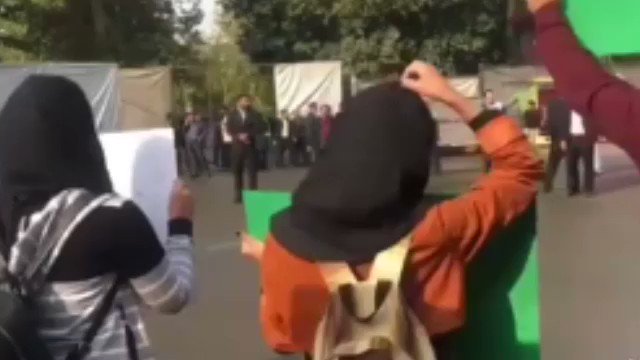
All the while, outside of the conference hall, students were seen protesting against the Iranian regime.


October 14 - Tehran,
Tehran University students protesting during Iranian regime President Hassan Rouhani's speech at the college conference hall.


The root of Iran’s crises is found inside the country and the all-out war between the Iranian people and the entire mullahs’ apparatus.
The mullahs’ regime is on the brink of collapsing. This can be seen in the people’s popular protests and “Resistance Units” linked to the Iranian opposition People's Mojahedin Organization of Iran (PMOI/MEK).
In such circumstances, there are only two options before the mullahs’ regime:
- Continue its policy of domestic crackdown, resulting in people’s wrath escalating and the expansion of protests that will ultimately lead to the regime’s overthrow.
- Another solution is to give in to the people’s demands. This will open rifts in the regime and result in the mullahs’ all-out crumbling, also eventually leading to the regime’s overthrow.sourse : english.mojahedin.org/i/iran-rouhani-hope-therapy

Wednesday, October 17, 2018

Iran and its popular alternative

Iran and its popular alternative


Now is the time to end the silence and place those responsible before justice
Analysis by PMOI/MEK

Iran, Oct. 17, 2018 - Iran stands at the threshold of another revolution. Following decades of unrests, protests and major revolts in July 1999 and the 2009 uprising, we are now witnessing the continuation of an uprising that began in late December 2017, quickly spread across the country and continues in various shapes and forms today.
Looking at the big picture, in one side we see a religious dictatorship squandering Iran’s vast national wealth, coupled with ruthless suppression and executions. While on the other side are the Iranian people and their resistance movement. Evident is the regime’s powerful crackdown machine is shrinking and weakening as the mullahs sink further into a growing crisis.
Let us see what regime insiders say about all this.
“We occupied the US embassy, which led us to the start of sanctions and the (Iran-Iraq) war began afterward. We insisted on continuing the war even after retaking Khorramshahr. However, when [Iranian regime founder] Khomeini accepted the UN ceasefire resolution he described it as “drinking from a chalice of poison. While the reconstruction work had hardly begun after the war, we started work on the nuclear program. This came with a very high price tag and we had to once again accept the ‘heroic flexibility’ in regards to the Iran nuclear deal. The ink on this deal had hardly dried that we started to fire missiles, giving reasons to those seeking to escalate the crisis,” said Gholamreza Heydari, a member of the Iranian regime Majlis (parliament).
“The severe downfall in the national currency value and skyrocketing prices for basic necessities indicate that the country is not being governed properly. Are we the guardian of the whole world that it is upon us to give blood for others’ sake? The way the country is running is that all the power is in one place and others are held accountable,” he added.
Revolutionary Guards deputy chief Hossein Salami also made interesting remarks recently.
“Our warehouses are full with basic necessities. The nation should increase their tolerance. For the love of God, do not be deceived by the enemy’s media and psychological warfare campaign… Remain calm… Nothing has happened. It is our enemy who should be terrified and shaking with fear…” he said.
These remarks of helplessness and defeat by senior officials are in stark contrast with the public’s growing popular resistance and determination. However, we need to examine this new reality and see how it came about, who made it possible and at what cost.
Reports seen in the press involve water shortages, corruption, lack of free election, executions, the disappearance of prisoners and … wide political unrest…
The reason is the endpoint for this regime is near and what you are witnessing is that major change period. Now there are many asking is there an alternative to this regime.
The answer is yes and this alternative can be found in the Iranian Resistance, the People's Mojahedin Organization of Iran (PMOI/MEK) and the opposition President Maryam Rajavi.
The PMOI/MEK fought against the Shah leading to the 1979 revolution. It is the force now fighting against the religious dictatorship and paying the price all these years.
“Let me read to you something coming out of the regime itself about the PMOI/MEK. ‘Who has the best conditions of seeking to overthrow and the ability to turn this potential into reality? It is talking about the reality of the regime overthrow. Everyone is pointing to the MEK and this is something that Iranian regime Supreme Leader Ali Khamenei has stressed upon repeatedly. So, it is necessary that we identify them, raise awareness about them and, all of us, be serious to confront this real threat,’” Mayor Rudy Giuliani, lawyer of U.S. President Donald Trump, said at an Iranian opposition rally recently.
This is the full picture of the Iranian Resistance. It rose early on when Iranian regime founder Khomeini began violating people’s rights and freedom. And, this movement has grown step by step, with many of its members sacrificing their lives to reach the status quo. This resistance refused to accept and give legitimacy to religious dictatorship disguised in the absolute rule of the clergy.
For almost four decades, the Iranian Resistance has been the only serious and lasting entity against this tyrannical regime. This movement embodies all progressive and freedom loving groups.


The third option

For a long period, the Iranian regime has led a misinformation campaign claiming the Iranian people and the international community had to choose between a full-scale military intervention or accepting the regime’s existence and tolerate its behavior.
The Iranian Resistance presents a democratic, political alternative to the world led by Maryam Rajavi.
Over the last two decades, Mrs. Rajavi has spearheaded a worldwide campaign in the fight against fundamentalism and the terrorist-supporting regime of Iran. She has gained the support from many international, political and social figures, including former military officers, former ministers and current MPs from various countries of Europe, the Americas, the Arab World, and Australia.
Maryam Rajavi has successfully led an international community to fight the unjustified blacklisting against the PMOI/MEK in Europe and the United States. This labeling was part of a secret behind-the-curtain deal and the cornerstone of the West’s appeasement policy vis-à-vis Iran.
This unjust blacklisting was debunked in the United Kingdom in 2008, the European Union in 2009 and the U.S. in 2012.
Another major undertaking led by Mrs. Rajavi is the transfer of PMOI/MEK members from Camp Ashraf to Camp Liberty in Iraq, and eventually moving them out of Iraq to Europe, especially Albania, and beyond. This was an extensive and extended campaign involving many political and security risks.
Mrs. Rajavi successfully worked and negotiated with several governments and international bodies to complete this campaign.
Moving on, Mrs. Rajavi launched a campaign seeking justice for the victims of the 1988 massacre in Iran. For three decades, the international community has remained silent on this crime against humanity.
Now is the time to end this silence and place those responsible before justice.
Mrs. Rajavi is the President-elect of the National Council of Resistance of Iran (NCRI), a known coalition of Iranian opposition forces, with the PMOI/MEK as its core member.
The time is now for the mullahs’ overthrow. Victory is certain and Iran will be free.

Tuesday, October 2, 2018

German court orders the extradition of Iranian terrorist diplomat

German court orders the extradition of Iranian terrorist diplomat


A German court approved the extradition of Assadollah Assadi to Belgium
Analysis by PMOI/MEK

Bamberg, Oct. 1, 2018 - On Monday, the regional court of Bamberg region, Germany, declared it had approved the extradition of Assadollah Assadi, an Iranian diplomat involved in a foiled terrorist plot against Free Iran 2018, the largest annual Iranian opposition gathering
The Free Iran 2018 gathering, held on June 30, saw the attendance of tens of thousands of Iranians from across the world who support democratic regime change in their country. The event featured speeches by Mrs. Maryam Rajavi, the president-elect of the National Council of Resistance of Iran (NCRI), as well as politicians and dignitaries from different countries of the world. The rally’s guest speakers included Rudy Giuliani, lawyer and advisor to the U.S. President, Newt Gingrich, former Speaker of the U.S. House of Representatives, Stephen Harper, former Canadian Prime Minister, and Bernard Kouchner, former Foreign Minister of France.
European authorities arrested Assadi and five other people who were involved in a terrorist plot that aimed to detonate a bomb at the event. Assadi was responsible for the coordination of the attack and had personally delivered 500 grams of explosive material to an Iranian couple tasked with carrying out the attack.
In July, Belgian authorities had requested the extradition of Assadi. The Iranian regime had tried to raise diplomatic immunity as an excuse to avoid the extradition and trial of Assadi, but the German court declared "The wanted man cannot cite diplomatic immunity because he was on a several day holiday trip outside his host state Austria and not traveling between his host country and the state that dispatched him.”
Assadi was based in Vienna, Austria, since 2014, where he was responsible for coordinating the Iranian regime’s espionage and terrorist activities in Europe. He also did a stint as the third secretary in the Iranian regime’s embassy in Baghdad, Iraq, where he was actively involved in the Iranian regime’s terrorist plots against the PMOI/MEK and coalition forces.
In September, the NCRI held a conference in London, in which it warned against the Iranian regime’s escalating terrorist activities abroad, especially against members and supporters of PMOI/MEK and NCRI. In recent months, authorities in the U.S. and Europe have arrested several people linked to the Iranian regime and involved in spying and terrorist activities directed toward the Iranian opposition.
The NCRI and supporters of the Iranian opposition are demanding European countries to close down the Iranian regime’s embassies and expel its diplomats, which have a long history of carrying out terrorist activities in their host countries.

Friday, August 24, 2018

Iranian officials fearfully anticipate further protests


Iran regime is incapable of controlling the escalating nationwide unrest
Analysis by PMOI/MEK 

Iran, Aug. 24, 2018 - The Iranian regime’s supreme leader Ali Khamenei claims that the country is not faced with a dead end and its president Hassan Rouhani tries to convince others that the country has nothing to worry about. Meanwhile, Iran’s economic conditions continue to deteriorate every day and prices continue to soar, driving the Iranian society toward an explosion. Media outlets with ties to both factions of the Iranian regime are mocking Khamenei and Rouhani’s claims and warn against what is to come.
“The decrease of the people’s economic power is an important and dangerous issue and we must counter it,” the state-run Jahan-e Sanat newspaper, linked to the Rouhani faction, warns.
Pointing to the destruction of Iran’s middle class, Jahan-e Sanat further warns, “As the middle class diminishes and its members trickle to the lower classes, we should anticipate further protests.” Jahan-e Sanat concludes that the government no longer has the power and capacity to face the challenges it faces.
Amanollah Qaraee, a government official, points to another facet of this escalating crisis, which is the people’s large mistrust toward the regime. “In such a society, we’re moving toward implosion,” he said.
Ebtekar, another state-run newspaper, explained what “implosion” means, by writing, “If the people feel that the ruling power is hindering their lives, they will break it.”
These comments from different government outlets and officials fully show that the situation is spinning out of the government’s control and that the Iranian regime is moving toward a dead end. Meanwhile, the regime’s different factions are blaming each other for the country’s economic woes to try to control the escalating situation.
Eshaq Jahangiri, Rouhani’s Vice President, confessed to the economic corruption that is engulfing the entire regime while adding, “Corruption has unfortunately expanded and reached some of the highest authorities of the country. They didn’t prevent it when they could.” His remarks, published in Tasnim, were aimed at officials with ties to Khamenei’s faction.
In response, Keyhan, the mouthpiece of Khamenei, accused Jahangiri of being responsible for the corruption, inflation and currency crisis that has become problematic in the recent year.
The infighting between regime officials and factions is effectively fueling the protests in the country and the regime is finding it more difficult to get a hold of the situation.
The truth is that the regime in its entirety is responsible for the corruption that has stalled the country’s industries and is leading Iran toward economic bankruptcy. The only outcome of the regime’s efforts have been high prices, lower incomes, and higher unemployment rates.
But the Iranian regime’s real dead-end is its incapacity to control the escalating nationwide protests that are happening in every city and town of Iran. The regime’s own officials are warning that their ship is slowly sinking and none of them can do anything about it.