Showing posts with label #sanctions. Show all posts

Wednesday, July 17, 2019

Khamenei insists on continued JCPOA breaches

Khamenei insists on continued JCPOA breaches


Iranian regime Supreme Leader Ali Khamenei
Analysis by PMOI/MEK

Iran, July 17, 2019 - Merely one day after the European Union Council of Ministers’ session emphasized on the necessity for Iran’s regime to step back from its 2015 nuclear deal violations and abide by the agreement, Iranian regime Supreme Leader Ali Khamenei said this process will in fact continue.
“Our Foreign Minister is saying this very frankly that Europe has 11 commitments with us and they have not lived up to their end of the deal. Why should we? We have been loyal to our commitments in the JCPOA,” Khamenei said, using the acronym for the Joint Comprehensive Plan of Action. “Now we have started to decrease our commitments and they are angry, saying why are you decreasing your commitments? How rude! You had 11 commitments and failed to live up to even one. Why are you asking us to live up to our commitments? Now we have just begun decreasing our commitments and this process will certainly continue,” he added.
Khamenei also made remarks over the seizure of the Iranian regime’s “Grace 1” supertanker by the United Kingdom near Gibraltar based on violating EU sanctions on the export of oil to Syria.
“This will not go unanswered,” Khamenei threatened. “Now, we have the treacherous UK take on piracy. They have actually stolen our ship. This is legalized piracy. This is how they behave. They commit the crime and seek to provide a legal framework to it, claiming the reason was this or that. However, the truth is piracy. Of course, this will not go unanswered.” 

Wednesday, July 10, 2019

Iran regime broker in US accused of sanctions violations

Iran regime broker in US accused of sanctions violations


Weapons of mass distruction
Analysis by PMOI/MEK

Iran, July 9, 2019 - The Atlanta prosecutors office has accused an Iranian regime dealer of violating United States sanctions and plotting to export biological material from the U.S. to Iran against a United Nations resolution.
AP reported that when an Iranian academic by the name of Masoud Soleimani touched down on U.S. soil last fall, returning from Iran, federal authorities armed with a secret indictment arrested him on charges indicating he had violated trade sanctions by trying to have biological material brought to Iran. Nine months later, as tensions escalate between the two countries, Soleimani sits in a detention center just south of Atlanta.
Federal prosecutors say the attempted transport was illegal and secretly obtained an indictment against Soleimani in June 2018. Government officials revoked his visa and arrested him in October when he landed in Chicago.
Soleimani and two of his former students are accused of conspiring and attempting to export biological materials from the U.S. to Iran without authorization. The two counts each carry a maximum penalty of 20 years in prison.
The U.S. attorney’s office in Atlanta declined to comment, but prosecutors have argued in court filings that the comprehensive sanctions in place for years do not allow goods to be exported to Iran except under very limited conditions that don’t apply in this case.
The U.S. and other world powers announced an agreement with Iran in July 2015 that said that country would curb its nuclear activities in exchange for the lifting of international sanctions, though the U.S. did impose new sanctions after Iran tested ballistic missiles.
After U.S. President Donald Trump came into office, tensions escalated and he pulled the U.S. from the nuclear deal in May 2018. Prosecutors in Atlanta obtained an indictment against Soleimani the following month.

Monday, July 1, 2019

Sanctioning the main culprit in Iran

Sanctioning the main culprit in Iran


Iranian regime Supreme Leader Ali Khamenei and the Revolutionary Guards (IRGC)
Analysis by PMOI/MEK

Iran, July 1, 2019 - Sanctioning Iranian regime supreme leader Ali Khamenei and his apparatus, following hard-hitting sanctions on Iran’s Revolutionary Guards (IRGC), and targeting Iran’s petrochemical industry as a key financial artery for exporting and aiding terrorism, is an important step toward economically crippling the entire clerical establishment in Iran.
This victory, obviously, did not come accidentally and overnight. It was the result of four decades of efforts and pain and blood paid by a Resistance movement that was constantly focused on the main enemy of the nation, the mullahs’ regime, in order to topple it.
The Iranian opposition coalition National Council of Resistance of Iran (NCRI) has time and again insisted on the need to designate IRGC and the Ministry of Intelligence and Security (MOIS) as Foreign Terrorist Organizations (FTO), in the United States and as terrorist entities by the European Union.
Tehran’s key financial arteries financing the Supreme Leader, his office and apparatus, and its Gestapo-type terrorist forces, being the IRGC and Quds Force, must be blocked.
Sanctioning the supreme leader and his office is tantamount to blocking the path to plundering the wealth and livelihood of a nation already forced under the poverty line.
Khamenei recently said, “Corruption is like a seven-headed dragon in fictitious stories.” However, it is worth noting that the main head of this dragon is in Khamenei’s apparatus.
Sanctioning Khamenei means blocking any assets in the US belonging to Khamenei or his office, anyone appointed by him or his office, or anyone who’s assisted or acted on behalf of the properties. They also bar any bank that facilitates a significant transaction with those parties from the U.S. financial system.

Sunday, June 30, 2019

Senior Iran official complains over PMOI/MEK’s growing influence

Senior Iran official complains over PMOI/MEK’s growing influence


NCRI revelations of the Iran’s clandestine nuclear weapons program (File Photo)
Analysis by PMOI/MEK

Iran, June 30, 2019 - Following new U.S. sanctions targeting Iranian regime Supreme Leader Ali Khamenei, his office, and the entire apparatus under his control through an executive order issued by U.S. President Donald Trump, a senior official in Iran is complaining about the growing influence of the Iranian opposition group People's Mojahedin Organization of Iran (PMOI/MEK).
“[U.S. National Security Advisor John] Bolton has become the PMOI/MEK representative in the U.S. Alongside the U.S. President, they are receiving wrong advise and intelligence from the PMOI/MEK. This has resulted in their wrong decision-making,” said Ali Larijani, speaker of the mullahs’ Majlis (parliament).
In his remarks to the state-run ISNA news agency on Thursday, Larijani complained about the revelations made by the Iranian opposition coalition National Council of Resistance of Iran (NCRI) from back in 2002.
The NCRI blew the whistle on Tehran’s secret nuclear enrichment project in Natanz and the heavy water reactor in Arak, triggering a visit to Iran by the Director of the International Atomic Emergency Agency (IAEA), the UN nuclear watchdog.
“From the very beginning, the PMOI/MEK brought up Iran’s nuclear dossier and [the IAEA Director] followed up on the matter. Then three European ministers traveled to Iran. They said we will resolve the issue and Iran can continue its enrichment after some time. However, history has shown they were not able to deliver on their promises,” Larijani said.
“Various European countries are allies with the U.S. They planned INSTEX [a mechanism to supposedly bypass U.S. sanctions targeting the mullahs’ regime]. However, it is only in name and not practical,” he added.

Friday, June 28, 2019

Iran: Sanctions, Khamenei and his Majlis (parliament)

Iran: Sanctions, Khamenei and his Majlis (parliament)


Mostafa Kavakabian, a member of the regime’s Majlis (parliament) in Iran
Report by PMOI/MEK

Iran, June 27, 2019 - Following the U.S. sanctions against Ali Khamenei, the Iranian regime’s Supreme Leader, and a number of Revolutionary Guard (IRGC) commanders, the open-door session of Iran’s Majlis (parliament) turned to a scene of grievance for its members.
Members of Majlis, while condemning the U.S. new sanctions against legal and official figures of this regime, described the new actions a sign of its desperation. These sanctions are against international law, the mullahs’ state-run TV aired a program on Tuesday making such claims.
“Through the scenarios of Fujairah, Sea of Oman and the U.S. drone they want to minimize their failures by constantly raising these and such issues,” said Jamal Nobandegani.
“The Islamic Republic of Iran has reached relative economic stability and crossing the sanctions has become possible for us. This is something that the Americans have recognized too and therefore waging a psychological war against us,” said Jamali Nobandegani, another member of the Majlis. 
“Apparently, the U.S. will not stop its stupid actions. In addition to the Supreme Leader and military commanders, Iranian regime Foreign Minister Mohammad Javad Zarif is also sanctioned. This means that the U.S lies that it seeks negotiations, the use of diplomacy and defusing tensions. I call upon our Foreign Ministry to send diplomatic responses to the countries cooperating with the U.S. such as the UAE, Bahrain, Saudi Arabia, and the United Kingdom,” said Mostafa Kavakabian.
“Last night, I tweeted to Mr. Zarif that it is time for John Kerry to show up and delist you!” said Mashhad Majlis member Karimi Ghodosi.

Tuesday, June 25, 2019

U.S. imposes new sanctions on Iran targeting Khamenei

U.S. imposes new sanctions on Iran targeting Khamenei


U.S. President Donald Trump
Report by PMOI/MEK

June 24, 2019 - U.S. President Donald Trump signed an executive order on Monday imposing new sanctions on Iranian regime Supreme Leader Ali Khamenei and his office in a strong measure aimed at designed to escalate pressure on mullahs in Tehran.
Trump imposed sanctions on Khamenei and eight senior Revolutionary Guards (IRGC) commanders. The U.S State Department recently designated the IRGC as a “Foreign Terrorist Organization” (FTO).


The U.S. President told reporters at the White House on Monday that the sanctions will deny Khamenei and his office access to financial resources, valued at 200 billion dollars, according to a recently released statement by the U.S. Embassy in Baghdad.
“The supreme leader of Iran is the one who ultimately is responsible for the hostile conduct of the regime,” Trump said.
To this day, Washington has sanctioned more than 80% of the regime’s economy in Iran, according to Secretary of State Michael Pompeo, currently in the Middle East to meeting with leaders of Saudi Arabia and the United Arab Emirates.
The U.S. Treasury Department said Monday those sanctioned also include eight officials of the Guard Corps who supervised “malicious regional activities,” including its ballistic missile program and “harassment and sabotage” of commercial ships in international waters.
Treasury Secretary Steven Mnuchin said at a news conference in Washington that some of the sanctions had been “in the works” and others were a result of “recent activities.” He said sanctions against the Islamic Republic have been effective in cutting off funds to the military and “locking up” the Iranian economy, and that the new penalties would be effective as well.
Mnuchin said the U.S. is set to impose financial restrictions on Iranian regime Foreign Minister Mohammad Javad Zarif “later this week.”
Trump told reporters Monday that, “A lot of restraint has been shown by us, a lot of restraint -- and that doesn’t mean we are going to show it in the future, but I thought that we want to give this a chance,” he said.
Any financial institution that knowingly assists with a financial transaction for those who were sanctioned could be cut off from the U.S. financial system, according to the Treasury.
Trump had warned of additional sanctions on Saturday. The U.S. is currently sanctioning nearly 1,000 Iranian entities, including banks, individuals, ships, and aircraft. In May, the Trump administration prohibited the purchase of Iranian iron, steel, aluminum, and copper.

Monday, June 24, 2019

Iran nuclear deal: A glimmer of hope or a trap for regime change?

Iran nuclear deal: A glimmer of hope or a trap for regime change?


The Joint Comprehensive Plan of Action (JCPOA)
Analysis by PMOI/MEK

Iran, June 24, 2019 - Tensions between Iran and the international community are increasing dramatically over the Joint Comprehensive Plan of Action (JCPOA), also known as the 2015 nuclear deal.  The current circumstances beg the question whether the JCPOA, which just until recently was the focus of hope for the ruling theocracy in Tehran to escape its domestic crises, has now become a trap placing the regime at a crossroads leading to regime change either way.
Despite the tough positions adopted by the European trio - signatories of the 2015 Iran nuclear deal - Germany, United Kingdom, and France, over Iran’s 60-day ultimatum, Iranian regime Foreign Minister Mohammad Javad Zarif reiterated Iran’s position on June 21.
“The second phase of Iran’s measures will start on July 7,” he said.
Meanwhile, the European Union, which had previously said that it does not accept Iran’s ultimatums, ignored Iran’s threats once again and announced that “high ranking officials from France, Germany, the UK, China, Russia, and Iran will meet on June 28 in Vienna to talk about ways to rescue the nuclear deal.”
Alaeddin Boroujerdi, a member of the foreign policy and national security committee in the Iranian parliament, also confirmed statements made by regime President Hassan Rouhani and Zarif and said Iran won’t wait for European countries forever.
Some Iranian pundits warn about Europe’s position.
When asked whether Europe will be able to prevent Tehran from entering the second phase in the small remaining time window, Abdolreza Farajirad, Iran’s former ambassador to Norway, says: “Generally, all the efforts, and attempts by Europe can’t lead serious results proportionate with Tehran’s expectations. In this short period, in the best case, Europe will be able to take some steps to execute the first transactions of its financial mechanism.”
“That’s because the INSTEX financial mechanism is more suitable for providing basic goods and medicament than comprehensive trading relations with Iran. It appears that these countries will not be able to find a serious solution for Iran’s oil sales and banking transactions. This is not proportionate to Iran’s compliance to its obligations,” he added.
Farajirad then warns about Iran violation of the JCPOA.
“The overall developments are advancing in the path desired by the United States. Therefore, because of Europe’s concerns about Tehran’s measures, the circumstances are ripe for the position of the U.S. to get closer to the positions of Germany, France, and the UK, as much as the chances of disagreement between Iran and the European trio in the JCPOA are high, because of Iran’s actions,” he added.
Referring to the U.S. special representative for Iran, Farajirad continues: “Brian Hook’s presence in Paris is an attempt to pave the way for the U.S. and Europe to get along regarding Iran and the JCPOA, so that they can create more pressure. In addition to this goal, it is possible that the White House is trying to prepare the situation for drawing Iran’s file to the Security Council, so it needs the support of the European trio.”
Javan newspaper, close to the Islamic Revolutionary Guards Corps (IRGC), also warns about the visit of the European trio’s officials.
“Evidence suggests that the foreign ministers of the trio have planned this visit in order to persuade Iran to remain in the JCPOA. A scenario that, if not implemented [if Iran does not remain in the JCPOA], ‘Iran must face its consequences’, as put by [German Chancellor Angela] Merkel.

Friday, June 21, 2019

Iran: At the end of the road, fight over FATF

Iran: At the end of the road, fight over FATF


The regime in Iran is facing a major dead-end over the FATF
Analysis by PMOI/ MEK

Iran, June 21, 2019 - According to Iranian state-run media, next Thursday, June 27, is the last window for Iran to approve the remaining two bills that are needed to join the Financial Action Task Force (FATF), the world’s de facto body on money transaction transparency.
The regime’s Deputy Foreign Minister Abbas Araghchi has already declared the Islamic Republic’s position that unless the European Union creates a channel to circumvent U.S. energy sanctions, Tehran will not approve the FATF bills.
That is why the mullahs have threatened to gradually back off from obligations under the 2015 nuclear deal, known as the Joint Comprehensive Plan of Action (JCPOA) if Europe fails to take appropriate measures in a 60-day time frame. Obviously, Europe has rejected the Iranian regime’s ultimatum and once again escalated the controversy over FATF bills in Iran.
The June 18 public session of Iran’s Majlis (parliament) was another scene of the Islamic Republic’s officials from different factions fighting over the fate of FATF bills.
Mohammad Javad Abtahi, a Majlis member close to Iranian regime Supreme Leader Ali Khamenei’s faction, revealed that Rouhani’s cabinet has already implemented parts of the bills before they have been approved.
“It’s interesting for you to know that among this turmoil, the honorable government has a resolution on June 15 with the number 33852t 56650… What is this resolution?… An amendment to the 6th provision of the combating money-laundering law from the FATF resolutions that the parliament has yet to decide upon and the Expediency [Discernment] Council has not passed yet. A few days ago, the government obliged its institutions to implement it. Nobody complains in this country why the government is circumventing the law? What is this resolution?… Isn’t this circumventing the law? Look, they say we are blocking the path of engaging the world. By god, no! We say, just respect the rule of law!” he said.
The Fars news agency, close to the Islamic Revolutionary Guards Corps (IRGC), writes about the aforementioned resolutions.
“On the eve of the latest FATF sessions, the government has taken a new measure to implement the program of this international institution. Another part of this program has been approved by the government and the first deputy of the president has communicated it to the related institutions,” the report reads.
Meanwhile, Qasem Mohebali, former head of the Middle East and North Africa desk in the regime’s Foreign Ministry, reveals the truth of the dead-end the Iranian regime faces when it comes to the FATF. “The FATF is the foundation of INSTEX. If Iran wants Europe to succeed in implementing the INSTEX mechanism, the FATF bills need to be approved. This has been delayed and the fate of this issue will probably become clear in the latest FATF meetings. It appears that the INSTEX implementation hinges on Tehran implementing the FATF bills,” he explained.

Thursday, June 20, 2019

How Iran’s regime stalls on meeting FATF obligations

How Iran’s regime stalls on meeting FATF obligations


Iran’s regime is desperately battling the FATF crisis
Analysis by PMOI/MEK

Iran, June 19, 2019 - The Financial Action Task Force (FATF), the international body tasked with fighting global financing of terrorism and money laundering, is currently convening in Orlando, Florida, and will be deciding whether the Iranian regime is meeting its commitments toward making its financial system transparent. Tehran had been previously notified to pass the necessary laws to become conformant with the Palermo and CFT (Combatting Foreign Terrorism) bills, two necessary standards of the FATF. But since 2016, the regime has been stalling.
Failing to pass the necessary bills will put the regime on the FATF's blacklist of high-risk states. This will make Tehran subject to countermeasures to protect the international banking system and will make it much more difficult for the mullahs to finance their terrorist agendas and proxies across the globe.
Previously, Abbas Araqchi, the regime's deputy foreign minister, had predicted the passing of the CFT and Palermo bills on the European Union launching INSTEX, a financial instrument that was supposed to enable the regime to circumvent U.S. sanctions.
Iran's state-run Channel 1 television reported that in a meeting with Helga Schmid, the secretary general of European Union external action service, Araqchi threatened that if the EU does not meet its commitments under the nuclear deal forged between Iran and world powers, the regime will take retaliatory measures on its obligations, as its president Hassan Rouhani had previously declared.
"Our expectation is not only for the INSTEX to be launched, but to also include non-sanctioned goods. Otherwise, it will not meet its intended goals," Araqchi told the broadcast network.
Last week, in a parliamentary session, one of the MP from the National Security Committee lamented, "The Europeans did not meet their obligations. They gave us a package called INSTEX—they're selling us fertilizer and grains and food, which have not been sanctioned in the first place, and they're not paying us anything in return. They will not buy saffron and pistachios, they will not transfer cash… and they've set three conditions, including the dismantlement of our missiles, the stopping of our regional activities and the passing of the CFT and Palermo bills."
It is evident that, against the regime's wishes, the EU has not backed Tehran in its confrontation with the international community and did not respond to its demands on oil exports and banking transactions. Meanwhile, the regime continues to stall and deceive its counterparts under the pretext of "examining" the FATF bills.
On June 16, Fars News Agency, the media outlet of the IRGC, reported that the Joint Commission of the Expediency Council "convened for a second session to examine the possibility of the regime joining the CFT and Palermo bills."
Fars reported that the Expediency Council (EC) has submitted 11 questions to the government and will continue to hold sessions until it reaches a conclusion.
Interestingly, the EC session was taking place at the same time that the FATF was convening in Orlando to decide whether the regime has met its obligations after having been given three years' to pass the necessary bills.
The regime's Majlis has passed the bills, but the Guardian Council, an unelected body of clerics that oversees the conformance of legislation with the regime's Sharia laws, has rejected it. The EC, which is tasked with resolving disputes between the Majlis and the GC, has been stalling for months without taking concrete measures.
Ahead of the FATF meeting in Orlando, U.S. Secretary of State Mike Pompeo declared that the Iranian regime had “utterly failed to meet its commitments under the Financial Action Task Force action plan that it had agreed to.” Germany, Britain, and France made similar calls in a joint statement in January, in which they urged Tehran “to swiftly implement all elements of its FATF action plan.”
The FATF bills are meant to keep global markets safe. But clearly, the regime is wasting time by ball-handling the bills between its many different organizations, trying to create the impression that it is working toward resolving the issue while not taking action. What's for sure is that any international standard that makes the regime's financial system more transparent and subject to oversight will be a blow to the mullahs' machinery of financing their illicit activities, circumventing global sanctions, funding terror groups and the likes of the brutal Assad regime in Syria.
Hossein Mozaffar, a member of the Expediency Council, made it clear that it is not in the regime's interests to become conformant with FATF standards on the same day that Pompeo made his statements about Tehran's failure to meet its commitments. “The kind of transparency that FATF seeks … is to find out our ways for bypassing sanctions,” Mozaffar said. “For a country under sanctions, it is a very unwise move to show our hands and let them see and block all our strategies.”

Monday, June 17, 2019

Iran: Increasing controversy over negotiating with the U.S.

Iran: Increasing controversy over negotiating with the U.S.


Negotiations with the US is driving the rift between factions of the regime deeper
Analysis by PMOI/MEK

Iran, June 17, 2019 - The Iranian regime President Hassan Rouhani’s so-called moderate faction is insisting on the necessity of negotiations, and any potential opposition to negotiations as catastrophic for the future of the Islamic Republic. This is despite the Iranian regime Supreme Leader Ali Khamenei’s public opposition to any type of negotiations, let alone relations with the U.S., and his latest reiteration of this stance in his meeting with Japanese Prime Minister Shinzo Abe.
On the other hand, media outlets close to Khamenei’s faction attack proponents of negotiations and describe it as treason, and self-deprecating.
The Iran Newspaper, the Rouhani cabinet’s official mouthpiece, considers the idea of negotiations per se as positive, despite Shinzo Abe’s fruitless visit, reasoning that it has broken the taboo of negotiating with the U.S.
“Suggesting the subject of negotiating with the U.S. per se by media outlets that leads to breaking the taboo of negotiating with this country is a positive development. It may seem that the visits of some high-ranking official to Iran have not borne fruit. However, just the use of the word negotiation in political and media circles shows that until now Iran has acted intelligently and its moves are part of positive diplomacy,” Iran newspaper writes.
Mehdi Motaharnia, a political pundit close to Rouhani’s camp, clearly points to the rift between the government and Khamenei about negotiating with the U.S.
“If we consider the government to be the president and the executive branch as a whole, we need to accept it that this government wants to pave the way to solve the issue between Iran and the U.S. through diplomacy. This would decrease tensions between Tehran and Washington in the region, and across the globe,” he said.
Motaharnia then names Khamenei and his camp as the “state” and admits that in the mullahs’ regime, the government has no option but to follow the Supreme Leader.
“The government is under the supervision of the state, and we can actually say that the government carries out its political interactions under the supervision and responsibility of the state. In the framework of the Islamic Republic of Iran, the government can’t act upon its opinions and doctrines without considering the will of the state,” he added.
Motaharnia then describes how Khamenei and his faction do not take responsibility for their decisions and political choices and say the consequences of negotiating or not negotiating will be upon the shoulders of the government at the end of the day.
“Like the important case of the 2015 nuclear deal [known as the Joint Comprehensive Plan of Action (JCPOA)] where the state started the negotiations and before the Rouhani government took power, the negotiations between Iran and the other side, especially the Americans, had already started in Oman. But the responsibility for the JCPOA remained on the shoulders of the government,” he added.
The Fararu website published an article titled, “The U.S. is seeking an international consensus against Iran”, and wrote: “The U.S. strategy is to pin down Iran. On the other hand, it wants to position itself in a way that the right is on its side and it can do take any measure it wants.”
“America’s first move to show the negotiations card and said that we are willing to negotiate with Iran. Generally, negotiations are a positive thing on the international stage. When a country says that we won’t negotiate, it is accused of avoiding diplomacy. Now, the Americans want to instill [the idea] that Iran will not negotiate. On the other hand, they accuse Iran of destabilizing the Persian Gulf and the Gulf of Oman to achieve their final goal,” the newspaper writes.
Media outlets close to the Supreme Leader attack the opposing factions reasoning and stance.
The Keyhan newspaper, the mouthpiece of Khamenei, writes in its editorial titled, “The last deception”: “If there are people who prescribe negotiations and ‘surrender in the face of coercion’, they are disqualified and they have no right to talk about human rights, freedom, human dignity and the like. They are the company of a caravan where, in the name of being pathfinders, they mislead the caravan to the midst of highwaymen’s ambush.”
Vatan Emrouz newspaper also published an article titled “The gift of Maas’ and Abe’s visit.”
“No one can claim that negotiating with Trump will bring some special economic results for Iran. At least under the current circumstances where he publicly throws the JCPOA into the wastepaper basket of the Oval Office in the White House, negotiating is nothing but stupidity and ridiculing oneself.”

Sunday, June 16, 2019

Iran oil production hits the lowest in 30 years

Iran oil production hits the lowest in 30 years


Oil facility in Iran
Reported by PMOI/MEK

Iran, June 16, 2019 Iran’s oil production in the month of May dropped to 2.4 million bpd, 210,000 barrels less than the month before, and the lowest since the 1980s, according to the Paris-based International Energy Agency (IEA).
Iran’s daily oil export in the month of May dropped to 810,000 bpd, 480,000 barrels less than the month of April, the IEA report emphasizes.
In early May, the United States began imposing comprehensive sanctions on the oil exportsof the regime in Iran with the aim of zeroing Tehran’s oil exports.


Read more:
The U.S. Treasury Department announced new sanctions targeting the Persian Gulf Petrochemical Industries Company (PGPIC), a firm linked closely to the regime’s terrorist-designated Revolutionary Guards (IRGC), 39 sub-companies involved in Iran’s petrochemical industry.
Washington sanctioning Iran’s petrochemical industry is tantamount to taking a major step towards “suffocating” this vital branch of the regime’s profiteering activities. U.S. Secretary of State Mike Pompeo is emphasizing on “maximum pressure” to deny any funds for the IRGC, according to Asharq al-Awsat.
The new sanctions arrive as Washington is increasing pressures on Tehran for its ballistic missiles and proxy wars across the region.
The U.S. Treasury said Iran’s oil ministry last year awarded Khatam al-Anbiya, the economic and engineering arm of the regime’s IRGC, ten projects in the oil and petrochemical industries worth $22 billion, four times the IRGC’s official budget.
The Treasury’s Office of Foreign Assets Control (OFAC) took action against Persian Gulf Petrochemical Industries Company (PGPIC), Iran’s largest and most profitable petrochemical holding group, for providing financial support to the Khatam al-Anbiya Construction Headquarters.
Additionally, OFAC is designating the PGPIC’s vast network of 39 subsidiary petrochemical companies and foreign-based sales agents.  PGPIC and its group of subsidiary petrochemical companies hold 40 percent of Iran’s total petrochemical production capacity and are responsible for 50 percent of Iran’s total petrochemical exports.
“By targeting this network we intend to deny funding to key elements of Iran’s petrochemical sector that provide support to the IRGC,” said U.S. Treasury Secretary Steven T. Mnuchin.
“This action is a warning that we will continue to target holding groups and companies in the petrochemical sector and elsewhere that provide financial lifelines to the IRGC,” Mnuchin added.”
Sigal Mandelker, the U.S. Under Secretary for Terrorism and Financial Intelligence, spoke of the IRGC’s malign influence.
“The IRGC systemically infiltrates critical sectors of the Iranian economy to enrich their coffers, while engaging in a host of other malign activities,” she said.
The Treasury Department says the IRGC and its major holdings, such as the Basij Cooperative Foundation and Khatam al-Anbiya, have a dominant presence in Iran’s commercial and financial sectors, controlling multi-billion dollar businesses and maintaining extensive economic interests in the defense, construction, aviation, oil, banking, metal, automobile and mining industries, controlling multi-billion dollar businesses.  The profits from these activities support the IRGC’s full range of nefarious activities, including the proliferation of weapons of mass destruction (WMD) and their means of delivery, support for terrorism, and a variety of human rights abuses, at home and abroad.
The US administration on April, officially designated the IRGC as a Foreign Terrorist Organization (FTO). According to U.S. law, any American dealing or transacting with the IRGC could be charged with support for terrorism and get 20 years imprisonment.

https://storage.googleapis.com/afs-prod/media/eed797db758b44f78c17c9f1e8e437ce/800.jpeg
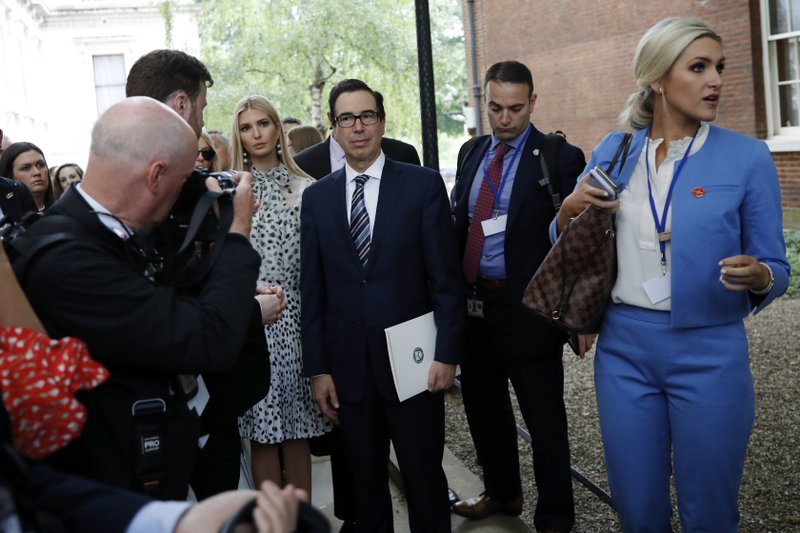
U.S. Treasury Secretary Steve Mnuchin, Senior White House Advisor Ivanka Trump and others. (AP Photo)


The following, targeted by the US Department of Treasury, are Iran-based Persian Gulf Petrochemical Industries Company subsidiary petrochemical firms owned or controlled by PGPIC.
  • Arvand Petrochemical Company
  • Bandar Imam Abniroo Petrochemical Company
  • Bandar Imam Besparan Petrochemical Company
  • Bandar Imam Faravaresh Petrochemical Company
  • Bandar Imam Kharazmi Petrochemical Company
  • Bandar Imam Kimiya Petrochemical Company
  • Bandar Imam Petrochemical Company
  • Bu Ali Sina Petrochemical Company
  • Fajr Petrochemical Company
  • Hengam Petrochemical Company
  • Hormoz Urea Fertilizer Company
  • Iranian Investment Petrochemical Group Company
  • Iranian Petrochemical Investment Development Management Company
  • Karoun Petrochemical Company
  • Khouzestan Petrochemical Company
  • Lordegan Urea Fertilizer Company
  • Mobin Petrochemical Company
  • Modabberan Eqtesad Company
  • Nouri Petrochemical Company
  • Pars Petrochemical Company
  • Pazargad Non-Industrial Operation Company
  • Persian Gulf Apadana Petrochemical Company
  • Persian Gulf Bid Boland Gas Refinery Company
  • Persian Gulf Petrochemical Industry Commercial Co.  (PGPICC)
  • Persian Gulf Fajr Yadavaran Gas Refinery Company
  • Petrochemical Industries Development Management Company
  • Rahavaran Fonoon Petrochemical Company
  • Shahid Tondgoyan Petrochemical Company
  • Urmia Petrochemical Company
  • Hemmat Petrochemical Company
  • Petrochemical Non-Industrial Operations & Services Co.

The Treasury’s Office of Foreign Assets Control (OFAC) is also designating four more companies to its sanctions list. They include:
  • Ilam Petrochemical Company,
  • Gachsaran Polymer Industries,
  • Dah Dasht Petrochemical Industries pursuant to E.O.
  • Broojen Petrochemical Company

Additionally, the Treasury’s OFAC announced that:
The UK-based NPC International
Philippines-based and NPC Alliance Corporation
UAE Based Atlas Ocean and Petrochemical and Naghmeh FZE are also being designated for acting for or on behalf of PGPICC.

The U.S. Treasury statement says international companies continuing to partner with PGPIC and its designated subsidiaries/sales agents will themselves be exposed to U.S. sanctions. The Treasury urges international companies to ensure they are conducting the necessary due diligence to avoid engaging in sanctionable activity with entities that support the Iranian regime’s malign measures.