Showing posts with label #terrorism. Show all posts

Tuesday, August 6, 2019

Iranian opposition reveals more aspects of Tehran-backed terror groups

Iranian opposition reveals more aspects of Tehran-backed terror groups


Tehran has a long history of providing money, arms and training to terrorists
Analysis by PMOI/MEK

Iran, Aug 5, 2019 - As tension between Iran and the West over the seizer of cargo ships and oil tankers by the Iranian regime is escalating, some Western intelligence agencies believe that the clerical regime ruling Iran has organized and funded sleeper terror cells across Europe including the U.K. that could attack on a green light by the Iranian regime in response to a conflict in the Gulf.
In an article titled “Iran’s ‘proxy’ terror army with cells ready to strike across West exposed” the Daily Star of UK cited a warning from the Iranian opposition group, the MEK, saying, the People's Mojahedin Organization of Iran (PMOI) - an opposition group which advocates the overthrow of the regime - warned the worsening political situation will see more use of these so-called proxies.
Other security agencies and groups have also acknowledged the existence of such sleeper cells.
Security intelligence group StratFor earlier this year detailed the spread of these forces - with Iran believed to have linked forces in at least six countries in the Middle East.
The Daily Star added that Operations linked to Iran reach deep into Europe and in the US as part of the regime’s use of “proxy” terrorist groups. And all of these are overseen by the military group known as the Quds Force, watched over by the powerful Revolutionary Guard (IRGC) which are both designated as a terrorist organization, FTO, by the US State Department.
According to an Iranian opposition official, Iran’s proxy groups have been engaged in terror acts including bombings, car bombs, missile firing and assassinations.
Shahin Ghobadi, the spokesman for the Iranian opposition MEK, warned we can see a “stepping up” of Iranian terrorist activity as the regime is “facing crises from all directions”.
Ghobadi told Daily Star that: “In this situation, the mullahs’ only solution is resorting to stepped-up suppression, more arrests inside Iran, and more terrorism and extremist measures abroad to maintain the regime’s balance and to prevent the situation from getting out of hand.
“Export of extremism, terrorism, and belligerence in the region have been a pillar of survival of the clerical regime for the past 40 years,” Gobadi added. “This pillar has complimented the other pillar, total repression, and suppression.”
“These two constitute the main pillars of the clerical regime based on the concept of 'Velayat-e-faqih', or the absolute rule of the religious leader,” according to Ghobadi.

Iran’s Quds Force under command of General Qassem Soleimani - reports directly to the supreme leader of fundamentalist regime of Ali Khamenei


The Daily Star article continues, it is estimated the force is up to 20,000 strong and is understood to be responsible for supporting and training proxy groups worldwide.
Stratfor’s analysis from earlier this year points to Iranian proxy forces being directly involved in Iraq, Lebanon, and Gaza.
And it marked out Iran providing material support for forces in Saudi Arabia, Syria, Afghanistan, Lebanon.
Terror plots and surveillance linked to Iran stretch much further than the Middle East, reaching into Europe, the Americas, Asia, and Africa.

Iran seized the Stena Impero as it passed through the Strait of Hormuz (Pic: GETTY)


Iranian proxies have linked to incidents in France, Denmark, Germany, the US, Argentina, Thailand, Nigeria and more.
“Iran's embassies, intelligence networks, and proxies give it a global reach,” StratFor said in an analysis of the ongoing tensions with the US.
It is also believed Iranian proxies have been responsible for six attacks on shipping in the Strait of Hormuz amid the new tanker wars.

Oil tanker attacked by Iran’s Revolutionary Guards (IRGC) in Gulf waters


PMOI officials also estimated they believe Iran is now linked to training foreign mercenaries as part of the proxies.
And one of the largest groups linked to the Iranian regime is the Lebanese Hezbollah, which is linked to attacks on US forces in the 1980s.
Ghobadi told Daily Star it is estimated that the Iranian regime continues to hand around $1 billion every year to Hezbollah.
“Hezbollah has played a key role in the regime’s terrorism even outside of the Middle East,” he said.
“Hezbollah explicitly confessed that Iran provides everything, from money to weapons, ammunition, food, and clothing to Hezbollah and that without the clerical regime in Iran, Hezbollah cannot continue its survival.”
Iran is also linked to the ongoing war in Yemen, with the regime believed by the PMOI to be supporting Houthi rebels who have staged numerous attacks on Saudi Arabia.
“It provides them with missiles and other weapons and equipment,” Ghobadi said.
“In addition to warfare, the proxy groups have been engaged in terror acts, bombings, car bombs, firing missiles and similar acts that result in heightened tensions in the region.”
Iranian terrorist groups have also been linked to the cyber-attacks on UK infrastructure - including on MPs in 2017 and on government email servers in 2018.
Ghobadi told Daily Star Online the rise of the proxies can be linked to the Iraq War in 2003, which “opened the doors to the regime as a gateway to the rest of the region”.
He also claimed that “until two years ago, [the Iranian regime] paid no price for its outlaw conduct” - which is helping to fuel the expansion of the proxies.
More sanctions must be placed on the leadership of the Iranian regime and they should be designated as “terrorists”, Gobadi added.
“The ultimate solution is regime change by the Iranian people and the Resistance. The West should recognize the right of the people of Iran and the Resistance for regime change and should stand on their side.
“The clerical regime has never been as weak as today, and the prospect of its overthrow has never been so close.”

HMS Duncan and HMS Montrose have been given instructions to escort all British shipping in the Strait of Hormuz amid fears of further seizures after the capture of Stena Impero.

Thursday, July 4, 2019

Iran parliament speaker: PMOI/MEK created our nuclear mess around 20 years ago

Iran parliament speaker: PMOI/MEK created our nuclear mess around 20 years ago


Iran has a suspicious and clandestine network of nuclear sites
Analysis by PMOI/MEK

Iran, July 4, 2019 - Iran’s recent measures of violating the 2015 nuclear deal by increasing its uranium enrichment stockpile over the 300-kilogram limit and promising to elevate the enrichment level above 3.67 percent is facing stiff international condemnations and warnings. This includes strong remarks from the United Nations Secretary-General Antonio Guterres, the United States and European countries, and even Russia and China.
This turn of events is causing major concerns for senior Iranian regime officials in Tehran that are making remarks about the roots of the mullahs’ nuclear dilemmas.
“If you remember, around 20 years, when the [PMOI/MEK] revealed that story regarding our nuclear dossier, leading to [IAEA Director General Mohamed] El-Baradei coming to Iran. The Americans then started making a lot of noise… They launched their psychological tactics against Iran on the international stage and began placing pressures. To this day, it has been nearly 20 years that we are involved in this issue. Why? Iran says we do not seek nuclear weapons. When [Iranian regime Supreme Leader Ali Khamenei] issues a fatwa saying it is forbidden, they would not understand. All in all, things cannot be changed,” said Iranian regime Majlis (parliament) speaker Ali Larijani.
“It is very unfortunate that recently [U.S. President Donald] Trump has sanctioned [Khamenei]. All right, sanction all you want; what does he have for you to sanction. It shows how much they fail to understand that Iran’s leader is a religious leader with millions of followers. With your measures, you are installing hatred in all their hearts. This further goes to show how they fail to understand Iran’s culture,” Larijani added.
Despite all the brouhaha made by the regime’s apologists and lobbyists abroad about sanctions targeting Khamenei being futile, these remarks by Larijani further prove how deeply concerned Tehran truly is of the sanctions against Khamenei who owns hundreds of billions of dollars, according to US officials.

Wednesday, June 12, 2019

Iran regime proxy terror group stockpiled explosives in London

Iran regime proxy terror group stockpiled explosives in London


Hezbollah Terrorist group plotted bomb attack in Britain
Reported By PMOI/MEK


London, June 10, 2019 - A report by Britain's Telegraph on June 9 revealed that a terrorist group affiliated to the Iranian regime had been stockpiling explosives in London.

The report said that on September 30, 2015, the UK security forces raided a potential British bomb factory alongside three businesses and one residential address. They arrested Iranian regime agents and discovered thousands upon thousands of small packages gathered together, each one containing ammonium nitrate - a common component in homemade bombs. 

The same component that had been used to kill 168 people in Oklahoma City in 1995 and 202 people in Bali in 2002. 

The factory was run by one of the Iranian regime’s most infamous proxy groups, Hezbollah. The storage was not in isolation but part of an international Hezbollah plot to lay the groundwork for future attacks. 

Hezbollah receives millions of dollars in cash, weapons, food, facilities, and ammunition including missiles from the Iranian regime. Hezbollah’s leader Hassan Nasrallah has publicly confirmed the group's dependence on Iran's regime.

Friday, June 7, 2019

Iran: Khamenei’s role in recent UAE, Saudi terrorist attacks

Iran: Khamenei’s role in recent UAE, Saudi terrorist attacks


Hossein Shahroudi, representative of the Iranian regime Supreme Leader Ali Khamenei in the city of Sanandaj, western Iran
Analysis by PMOI/MEK

Iran, June 7, 2019 - Hossein Shahroudi, Friday prayer imam of Sanandaj, western Iran, acknowledged that the drone attacks targeting vital oil facilities in Saudi Arabia and the sabotage attacks targeting four oil tankers off the coast of the United Arab Emirates were carried out by the Iranian regime and directed specifically by the regime’s Supreme Leader Ali Khamenei.
Friday prayer imams in cities and towns across Iran are known as Khamenei’s personal representatives.
“Missiles are fired. Drones are sent. They have targeted the very U.S. defense systems that were supposed to provide protection. It has hit the Patriot system and yet they claim Iran is directing these attacks,” he said.
“They said we will zero your oil exports. So what? Do so if you can. Two or three incidents took place. They could not pinpoint any of them to Iran. The Fujairah incidents took place. A few ships collided with each other. And then those oil transferring systems. They thought they could transfer their oil without using the Persian Gulf by taking it to the Red Sea saying it is safe through that route. Well, these drones went and targeted those pump stations transferring this oil. They were severely damaged. Now transfer your oil. See if you can?” Shahroudi continued in his remarks.
“A bomb exploded in a military base in Tel Aviv. What happened? What are these incidents, all one after another? Everyone denied it. These things do not happen on their own. They must have a leader who knows what he is doing. Know that [Khamenei] himself is directing these incidents step by step,” he added.
Iran’s Revolutionary Guards (IRGC) is the main force behind the mullahs’ support for terrorism across the globe.
The U.S. State Department recently designated the IRGC as a “Foreign Terrorist Organization” (FTO).


Such terrorism has been a threat to waterways throughout the region.


Thursday, June 6, 2019

UN Security Council will receive tankers’ sabotage probe results

UN Security Council will receive tankers’ sabotage probe results


UN Security Council session
Analysis by PMOI/MEK

Iran, June 6, 2019 - The United Arab Emirates, Saudi Arabia, and Norway will on Thursday present to members of the United Nations Security Council the result of their investigations into the recent sabotage attack targeting four oil tankers off the UAE coast near the Fujairah port.
This report was provided by Channel News Asia on Wednesday citing unspecified diplomatic sources. The U.S. is insisting that Iran was behind the attacks.
U.S. National Security Advisor John Bolton says Iranian made sea mines have most likely been used in these sabotage attacks.
Last week Ambassador Bolton said his country will provide the Security Council with documents showing Tehran’s involvement in the Fujairah bombings.
During his trip to London, Bolton reiterated the Iranian regime’s threats in the Middle East have not come to an end, insisting U.S.’ “immediate” reaction to Iran’s threats helped neutralize these threats.
The Wall Street Journal cited Ambassador Bolton’s comments on Wednesday saying the U.S. has little doubt that Iran was behind the attacks.
 “Who else would you think was doing it?” he asked, declining to give details of the assessment. “Somebody from Nepal?”
Another U.S. official told the WSJ that on the night of the tanker attacks, an American destroyer, the USS Mason, tracked 20 Revolutionary Guards (IRGC) sea vessels leaving Iran, crossing international waters and entering UAE waters near the port of Fujairah, where nearly 100 tankers were waiting to pass through the Strait of Hormuz.
The Saudi Gazette also cited Bolton saying the U.S. will next week provide the UN Security Council with findings showing Tehran’s in the oil tankers’ sabotage off the UAE coast.

Monday, June 3, 2019

Iran’s regime responds to Arab conferences

Iran’s regime responds to Arab conferences


Leaders form the Arab World gathering in Mecca for a series of conferences focusing on regional threats emanating from Iran
Analysis by PMOI/MEK

June 3, 2019 - Three conferences held in the holy city of Mecca, Saudi Arabia, featuring leaders from a spectrum of Arab and Islamic countries, was deemed unprecedented in the past. This represented a significant political alignment of these countries against the mullahs' regime ruling Iran, especially as these conferences coincided with Tehran’s deceptive “Quds Day” rally.
While Tehran intended to hold its annual “Quds Day” rally to derive attention away from its recent acts of terrorism and warmongering, these Mecca conferences literally delivered a strong blow to the mullahs’ intentions as regional crises continue to escalate. Leaders of the Arab and Islamic countries emphasized on the issue of Palestine in the face of the Iranian regime’s sham “Quds Day” façade, terrorism and warmongering.
The conferences also strongly condemned the terrorist attacks carried out by Tehran’s proxy forces targeting four commercial ships off the coasts of the United Arab Emirates and vital oil facilities inside Saudi Arabia. Participants in these conferences called on the international community to rise to their responsibilities in safeguarding regional peace and security.
In a weak response, the mullahs’ regime issued a piece in a newspaper associated with the Revolutionary Guards (IRGC) indicating how the Mecca conferences delivered a deep impact on Tehran.
“… a number of Arab statesmen gathered in three consecutive conferences to point their arrow of threats towards Tehran. They condemned the Islamic republic’s foreign and regional policies,” the piece reads in part.


Arab reaction

The Iranian regime does not respect the sovereignty of neighboring nations, the London-based Asharq al-Awsat wrote citing Saudi Minister of State for Foreign Affairs Adel al-Jubeir. The Islamic world does not accept this regime’s behaviors. Two sessions of the Gulf Cooperation Council and Arab League leaders condemned the Iranian regime with a clear voice. The Organization of Islamic Countries Summit also condemned the Iranian regime’s behaviors, such as attacks on oil tankers and Saudi oil facilities, al-Jubeir added.
Iran’s IRGC is the main force behind the mullahs’ support for terrorism across the globe.
The U.S. State Department recently designated the IRGC as a “Foreign Terrorist Organization” (FTO).


Wednesday, May 22, 2019

Iran regime quadruples enriched uranium production

Iran regime quadruples enriched uranium production


Iran is announcing higher production pace of low-enriched uranium
Analysis by PMOI/MEK

Iran, May 22, 2019 - Iran’s mullahs have quadrupled their low-enriched uranium production rate amid heightened tensions between the U.S. and Iran, according to the Associated Press citing semi-official news agencies in Iran on Monday.
A quadrupling of LEU production would mean the Iranian regime will likely go beyond the stockpile limitations set by the 2015 nuclear deal, according to AP.
On May 8, Tehran announced it would stop complying with a 300-kilogram cap on the storage of enriched uranium under the nuclear deal. The mullahs’ regime announced it would not comply by limits on uranium enrichment unless Europe throws an economic lifeline within 60 days, setting an ultimatum for the survival of the agreement.
Iran says the production of uranium enriched to the 3.67% limit is set by the 2015 nuclear deal with world powers.
Iranian regime President Hassan Rouhani addressed government officials on Monday in this regard.
“We have informed the heads of five governments that we will stop complying with two measures that we have been doing all along. These two measures are in a simple language two act of selling. Meaning whenever our enriched uranium stockpile would reach 300 kilograms, we would sell the excess amount to another country and receive yellow cake in return. This procedure will stop now.
“The second sale was our heavy water. Whenever we would reach our maximum permitted limit of 130 tons, we would sell the excess to another country. This procedure is also stopped now,” Rouhani explained.
The announcement by Rouhani came as the US State Department published a list of extra sanctions and limits on the mullahs’ nuclear program on May 3. The new sanctions and limitations imposed on Iran regime prior to the announcement by Rouhani were banning any purchase of enriched uranium from Iran. The US government also sanctioned any selling of heavy water by the Iranian regime.
Following Rouhani’s announcement of breaching Iran’s nuclear obligations, the United Kingdom, France and Germany expressed deep concern over any violation of Iran’s JCPOA commitments. China also expressed refrain from any radical and drastic measures by the regime.
The UK Foreign Secretary Jeremy Hunt warned Iran not to “underestimate the resolve of the U.S.” amid heightened tensions across the Persian Gulf.
Hunt told journalists in Geneva on Monday that U.S. leaders “are not seeking conflict, they don’t want a war with Iran, but if American interests are attacked, they will retaliate. And that is something that the Iranians need to think about very, very carefully.” 
Hunt added that Britain has had extensive discussions with U.S. Secretary of State Mike Pompeo over Iran. He said he hopes Iran starts to “pull back from the destabilizing activities” it conducts in the region.

Sunday, May 5, 2019

Iran: Consequences of Zarif’s failed visit to the United States

Iran: Consequences of Zarif’s failed visit to the United States


Iranian regime Foreign Minister Mohammad Javad Zarif facing harsh criticism
Analysis by PMOI/MEK

Iran, May 3, 2019 - Iranian regime Foreign Minister Mohammad Javad Zarif’s recent visit to the United States ended miserably on April 28 and he left the U.S. empty handed. While Zarif was playing his scripted part in the U.S. to open a channel to stall the inevitable, the Iranian propaganda machine was busy celebrating and touting the move as a strategic win.
However, as the circus ended and the mullahs’ weakness loomed large in the aftermath of the media frenzy, both factions among the ruling elite sought to blame each other for the fiasco.
Fereydoun Majlesi, a former diplomat and political pundit close to the so-called moderate faction close to regime President Hassan Rouhani, blamed the Supreme Leader Ali Khamenei’s faction for Zarif’s failure.
“The foreign minister did his best to keep a door open. Yet the Israelis, referring to some chants in Iran, pretend that these chants threaten their existence,” Majlesi said. “It appears that in some cases, there is still an approach prevailing in the country that is similar to the thinking of the former president who was preparing to manage the world,” he added, referring to former regime president Mahmoud Ahmadinejad’s rhetoric.
Mehdi Motaharnia, another political pundit close to the moderate camp, refers to Zarif’s claim that he has the authority to negotiate and implicitly ask Khamenei to personally enter the field.
“The government and Zarif want to decrease the pressure. However, this endeavor will only be accepted by the other party when governmental elements [meaning Khamenei] officially approve it,” he explained.
Considering that he speaks about the government and its foreign minister, “governmental elements” cannot be anyone else other than Khamenei himself.
“The U.S. is serious this time around and will not heed what the government [meaning Hassan Rouhani and his faction] says,” Motaharnia further adds.
The Ebtekar newspaper, close to Rouhani’s faction, also writes: “In his visit to New York, Zarif showed Tehran’s desire to negotiate… Next month, the G7 will have their summit. The Big European and Asian powers’ stances in this regard will be determining.”
A number of elements close to Khamenei’s inner circle also could not hide their concerns about Zarif’s failure.
Mehdi Mohammadi, an Iranian security pundit, took to voice a strong warning. “In the ongoing strategic struggle between Iran and the U.S., reaching its pinnacle now, the focus point is the public opinion in Iran,” he explained.
He then implicitly expressed his concerns about popular discontent in Iran. “There are clear truths that are misrepresented by the U.S. and domestic Western lovers in order to channel the public opinion in Iran, even for a short while, in a direction that the U.S. can deliver a decisive blow [to the Islamic Republic]. This is the most important point that we should be aware of.”
It is self-evident that Zarif could never have raised the possibility of negotiations with the U.S. without Khamenei’s explicit approval.
Nonetheless, beyond the hype of Iran lobbies, Tehran’s weak stance is the clear message that all analysts are taking from Zarif’s approach, strategy and behavior during his visit to the U.S.
It is clear that the maximum pressure sanctions regime of the current U.S. administration is effective. The ruling mullahs in Tehran are feeling the pressure to the point that they are ready to come to the U.S. and give an exclusive interview with Fox News, hoping to drive a wedge in the Trump administration.
Whenever facing a real threat, the mullahs in Iran resort to stalling their adversary through prolonged negotiations, talks, and discussions about future talks that will mere lead to further negotiations. Unlike in democracies, unelected dictators can simply stall in the hopes of riding out the storm. This time, however, it appears to be different.

Monday, April 22, 2019

IRGC FTO designation further complicates Iran’s FATF dilemma

IRGC FTO designation further complicates Iran’s FATF dilemma


Iran regime is facing a quagmire dealing with FATF bills
Analysis by PMOI/MEK

Iran, April 22. 2019 - Even prior to Iran’s Islamic Revolutionary Guards Corps (IRGC) terror designation as a Foreign Terrorist Organization (FTO) by the U.S. State Department, infighting over the fate of the Financial Action Task Force (FATF) related bills amongst the mullahs’ regime were already escalating into dangerous territory.
However, the blacklisting of the Islamic Republic’s main armed forces takes the equation to the next level with far more at stake.
The two remaining bills necessary for Iran to join FATF, after considerable back and forth between the Majlis (parliament), the Guardian Council, and the Expediency Council, were referred to the latter for further study and a final decision.
For the mullahs’ regime, there are much at stake. In a nutshell, it is a strategic decision that will resonate far and wide throughout Iran’s current power structure and its relations with the international community.
However, despite the importance of the bills for Iran’s future, both in terms of its foreign relations and its internal form of government, the regime seems to be paralyzed and stuck at a crossroads that will take its toll one way or another.
Etemad online website writes: “The story of the FATF bills has become a tortuous odyssey. It is so twisted that the shadow of daily news and events looms large over it. Political controversies and their interpretations have reached a level where the FATF itself is forgotten.”
Laya Joneydi, deputy of legal affairs for Iranian regime president Hassan Rouhani, has also voiced concerns.
“Everyone, including the media, the government, the Majlis and the Expediency Council should help keep the discussion about the FATF professional and not political. If they make the discussion too much political, it may be that the issue is impacted by daily moods and news, resulting in a negative decision made,” she said.
“We don’t intend to change the government’s policy,” she said when asked about the impact IRGC’s designation on the FATF decision-making.
On the other hand, Abolfazl Zohrehvand, Iran’s former ambassador to Italy, disputed Laya Joneydi’s claims that there is no connection between the designation of IRGC and FATF.
“These two issues are very much related. If we fall into the trap of the combating terrorism financing (CFT), FATF and Palermo bills, the U.S. will have legal grounds to ask other countries to cooperate with it,” he said.
He then attacked the so-called moderate Rouhani cabinet.
“Some people are either not aware of this or, God forbid, one must suspect them of being the representatives of the West,” he added.
Amir-Hossein Ghazizadeh Hashemi, a member of the Majlis administrative board, also lashed out at FATF proponents.
“Today, pro-West voices who sought the four bills approved and joining the Palermo and CFT conventions must have realized that the opponents of these bills have been realists and had good a grasp of the true nature of the international community. But the pro-Wests, through illusion and optimism, have almost put the country into the West’s trap,” he warned.

Wednesday, March 20, 2019

Two Iranians arrested entering Argentina with fake Israeli passports

Two Iranians arrested entering Argentina with fake Israeli passports


Argentine police broke up a major fake passport ring led by an Iranian regime
Prepared by PMOI/MEK

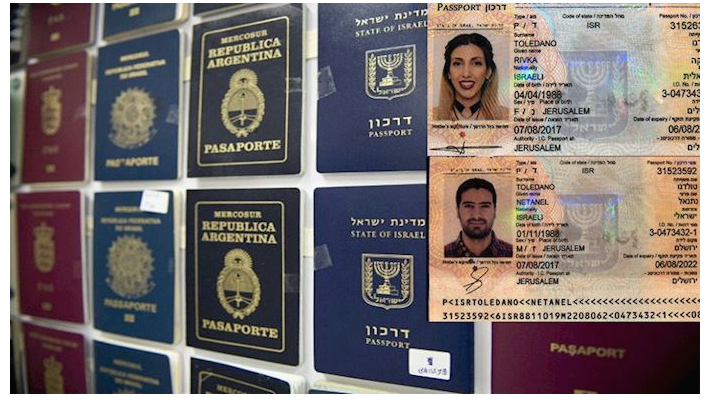
March 18, 2019 - Argentine intelligence arrested two Iranian nationals carrying fake Israeli passports.  
Two Iranian nationals linked to the Iranian regime were arrested in Buenos Aires traveling on forged Israeli passports, just a day before the 27th anniversary of the March 17, 1992 bombing of the Israeli embassy in Buenos Aires.
27-year-old Sajjad Naserani and 30-year-old Mahsoreh Sabzali—were arrested last week after entering Argentina as Netanel and Rivka Toledano, carrying passports replete with mistakes, including the spelling of “Israel.”
The ID numbers the couple used reportedly belong to a real-life French-Israeli couple, according to Argentinian media.
The two Iranians arrived in Buenos Aires from Spain. Authorities are treating the couple as possible terror suspects and have since raised the level of alert in Argentina, local daily Clarin reported.
The passports' numbers had been listed by their owners as lost or stolen, under different names. This was flagged by the Argentinian border authority after the couple, arrived at Ezeiza international airport.
This led to an investigation involving Israeli police, and the eventual arrest of the two Iranians by the counter-terrorism division of Argentina's federal intelligence agency, AFI. Their phones and camera were confiscated.
Authorities initially suspected the passports had been stolen but later concluded they were forgeries after finding numerous Hebrew spelling mistakes on the official documents.
The investigation is especially sensitive as it comes amid commemorations for the March 17th, 1992 bombing of the Israeli embassy in the Argentinian capital.
The suicide car bomb attack, which killed 29 and injured 242, was carried out by the Iran-backed militant group.
An attack on the AMIA Jewish center just two years later, on July 18, 1994, left another 85 people dead and hundreds injured. Both attacks were attributed to Iran and its proxy, Hezbollah.

Firemen and rescue workers walk through the debris of Israels Embassy after a terrorist in Buenos Aires, Argentina, March 17,1992


Read More:
On July 18, 1994, a Renault utility truck packed with explosives smashed into the AMIA building in the busy downtown area of the Argentine capital, leaving a scene of absolute carnage in its wake. The bombing, which came two years after a nearly identical attack on the Israeli Embassy in Buenos Aires, an atrocity that killed 29 people, was similarly planned and carried out by the Iranian regime and its Lebanese proxy, Hezbollah.