Friday, March 8, 2019

Iranians from across U.S. join Iran Freedom March in Washington D.C.

Iranians from across U.S. join Iran Freedom March in Washington D.C.


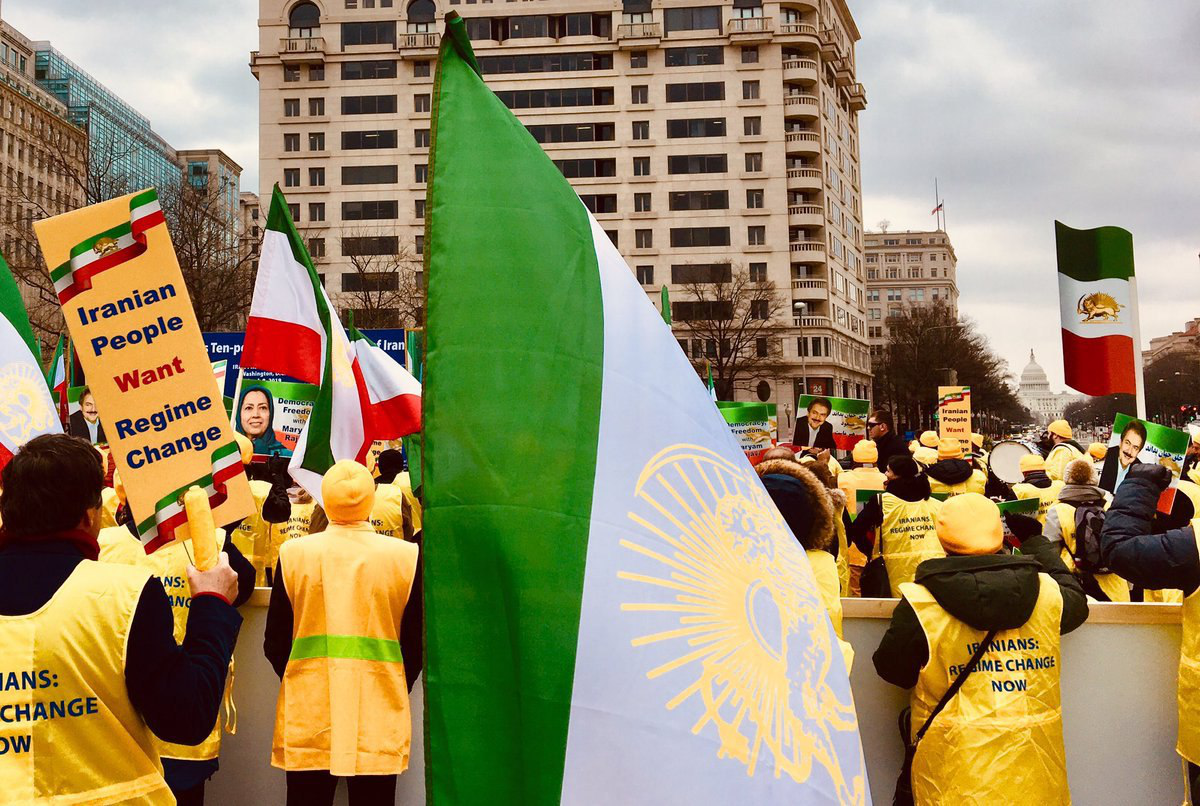
Iranian-Americans at the “Iran Freedom March” voicing support for ongoing protests in Iran, calling for the recognition of the Iranian Resistance against the mullahs’ regime - Washington, D.C. - March 8, 2019
Reported by PMOI/MEK


Washington D.C, March 8, 2019 -  On Friday, Iranians from more than 40 states across the U.S. gathered in Freedom Plaza, Washington D.C., to join the Iran Freedom March, a rally in support of popular protests in Iran. The demonstrators also voiced support for the National Council of Resistance of Iran (NCRI), the main Iranian opposition coalition which has been calling for the toppling of the tyrannical regime of mullahs ruling Iran and the establishment of a secular and democratic state.

The rally took place as the past 15 months have seen ongoing protests across Iran. People from all walks of life, all segments of the Iranian society and all corners of the country have been holding demonstrations, strikes and sit-ins for their most basic rights, trampled by the ruling mullahs for four decades. The people are holding the mullahs’ regime in its entirety for deteriorating economic conditions and lack of political and social freedom.

https://lh6.googleusercontent.com/yefqvFw3bSC0xZ_66Ba3Dq1qC26YmLNm52Rt9HoTmUHByqI-VPoJPac10RibG42NgSioN2HeB2oyXRmsKoU3-kTqU6jBEq_nJn6irwtC60Z1NAFlzmdx7EEWIONFc-K01Dq8lSYU
Iranian-Americans rallying at the “Iran Freedom March” - Washington, D.C. - March 8, 2019

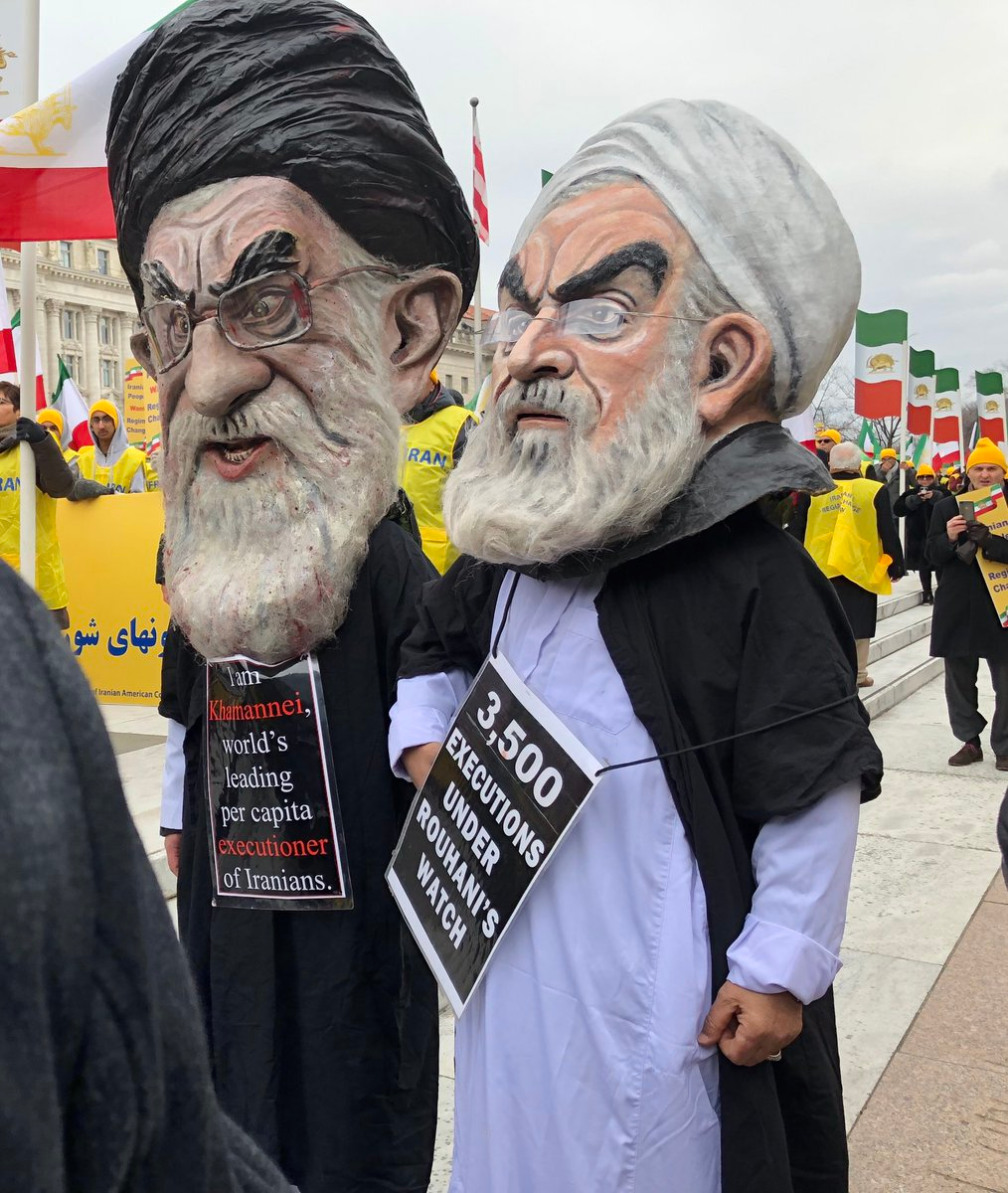
Protests over unpaid wages, high prices, low salaries, government corruption and the incarceration of activists have become a common scene across Iran. Slogans of regime change and calling off the government for its corruption have become increasingly popular in Iranian protests during the past year. “Down with Khamenei and Rouhani,” “Death to dictator,” and “The enemy is right here” are some of the slogans regularly chanted across Iran.

The year 2018, in particular, began in Iran with a nationwide uprising that lasted more than two weeks and encompassed all 31 provinces of Iran, spreading to more than 142 cities.


Participants in the Iran Freedom March were there to make sure the voices of their compatriots inside Iran were heard in the U.S. “Every Iranian shouts: Down with Khamenei and Rouhani,” the rally’s participants were chanting.

https://lh3.googleusercontent.com/iKnSRhIjIUtuskgCEPZ_HW-pjjOuD4jzOy4fDHP-xDIDZYBKXT21Ghir6PftgK-evDzw_RlYXKt1mulBtUp5dP0roxbT4bTqMJg1dWftYjInPV7d3RoMAFUR91v3sBidsiscF44Y
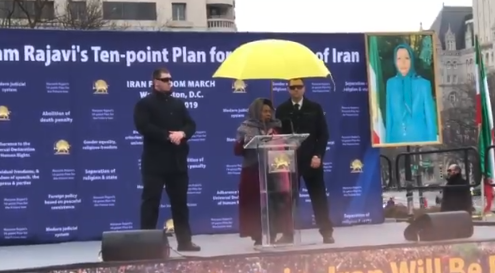
Iranian opposition NCRI President Maryam Rajavi sending a video message to the Iran Freedom March in Washington D.C. - March 8, 2019
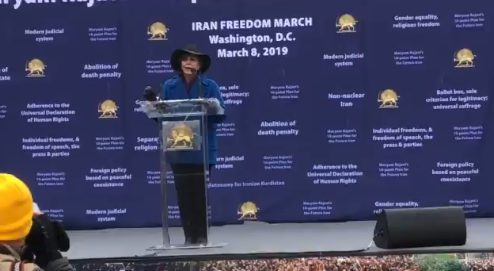
In a televised message to the rally, NCRI President Mrs. Maryam Rajavi marked International Women’s Day and the struggles of Iranian women for freedom in their country. “On March 8, I call on all women in the United States and around the world to support the fight of their sisters in Iran to overthrow the ruling regime,” Mrs. Rajavi said.

Mrs. Rajavi also underlined how the corrupt rule of the mullahs has driven the lives of the Iranian people into poverty, unemployment, inflation and a rash of economic, social and environmental crises. “So long as the clerical regime is in power, none of these ills will be resolved. The ruling mullahs will become ever more dependent on their devastating policies, namely the suppression of Iranian society, warmongering and destructive meddling in the region, money laundering, terrorism in Europe and the United States, and plundering the assets of the people of Iran,” Mrs. Rajavi said.


Ongoing protests in Iran and the continued activities of Iranian Resistance Units, networks of supporters of PMOI/MEK, have largely undermined the rule and power of the ruling regime, Mrs. Rajavi underlined. “The regime now faces one of the most difficult periods of its rule. The continued uprisings have destabilized the ruling structure. And there is no going back. Change in Iran is within reach more than any other time,” Mrs. Rajavi said.

Mrs. Rajavi underlined the NCRI’s a movement deeply rooted in Iran which is capable of overthrowing the regime and managing affairs during the transition so that the Iranian people can choose their true representatives through free and fair elections. “The international community is duty-bound to respect the struggle of the Iranian people to overthrow the clerical regime. This is essential for global peace and security,” Mrs. Rajavi said.

Rep. Sheila Jackson Lee of Texas delivered an inspiring speech at the gathering.
“I believe in what you believe in. The Iranian people want regime change. We want it in a peaceful manner. We want people to do it in a democratic manner and a strong manner. We want the nuclear capacity to be contained so that we can focus on the investment in the people of Iran. We thank you very much for the leadership that you have given. I am a believer in democracy. I believe in your strength, determination and perseverance. Never give up in the democracy of peace, in the democracy of strength,” she said.

https://lh5.googleusercontent.com/G_iyrcMnAS-bQcntI2PXN6_0XiiL02Ml6WpydFeVAgai3SeCq4Is7AF2iAFQgPiex53RSoMUYX9XQO1vt6sbu6g4F6oToisze6IhYRnj3BbQedPcjdUGp-b-9bm1ORJ8W8gs1rt1
Rep. Sheila Jackson Lee (TX) delivering a speech at the Iran Freedom March - Washington, D.C. - March 8, 2019

Rep. Brad Sherman of California sent a video message to the Iran Freedom March.
“The regime has demonstrated time and again that it is no friend of the United States and no friend of the Iranian people. As you know all, since it first came to power, the Islamic republic has exported terrorism around over the world. Just last summer, the Iranian Islamic republic tried to bomb your rally in Paris. Thankfully, that plot was foiled,” he emphasized.

https://lh3.googleusercontent.com/WIUBOe9aykn0wYbh7M-1NFjNCYN0xrvif7IS7xOpT9Y5p6ipI10ddwP5OqX87NTM05np6_oH_tt4Y0pzjYmawXaMnMEb5RoGohG2aYyWa07-g79AY3C5zHh410Iv7797ihH0N1oo
Rep. Brad Sherman (CA) sending a video message to the Iran Freedom March - Washington, D.C. - March 8, 2019

Linda Chavez, former White House Liaison Officer, delivered a speech condemning human rights violations in Iran and specifically criticizing the appointment of Ebrahim Raisi as the chief of the regime’s judiciary by supreme leader Ali Khamenei. Raisi was a member of a panel of judges who sentenced thousands of political prisoners to death in 1988. At the time, the Iranian regime executed more than 30,000 political prisoners, most of whom were members and supporters of the People’s Mojahedin Organization of Iran (PMOI/MEK).

“How can there be freedom when you have a monster who killed people of all ages, men, women, even pregnant women, children, young girls, 15 year old girls, tortured and then executed by this monster. So we must say no to this regime. We must press for freedom, for all of the things that Madam Rajavi has promised the Iranian people,” she said.

https://lh5.googleusercontent.com/M9vC0FO6iSl7EDxOtVS6UguKdm0MDSQbhqwcy9jges8iWc4fMbE09tKxrjT22mG37JiazMr2-oE4MmLt5ydTGM3Ki2lVmiIH_fVLjR04GiNqFMzEYZRZAcEWG9kdsgaLZYZcXh9V
Linda Chavez, former White House Liaison Officer, at the Iran Freedom March - Washington, D.C. - March 8, 2019


https://lh4.googleusercontent.com/akEgQMRrXW0kmUnpNYLmd-WDTLguXrZEucoyB1rutT27rihgyT10tf0MVcyFWF35nftcRpAlT8HM-Y9TCxyXWAXzrWfvRAs1Rqs5qWr0I9bcRt3Q1hFm-_KXwWqcLN2u_4x0ooNM
“Iran Freedom March” - Washington, D.C. - March 8, 2019

https://lh4.googleusercontent.com/M4P138F-su6fTr_h7xtsgncCIWvNIWyT-iQ4Asyud8FMLn3BoeHVxohsIU9-wnA915bD9RJzizHf4lm4sys8fXcacZrqMEenTV9kZpEjLh53qQ8IfOPzCV_hOUzaV-2wFe6eH2Dh
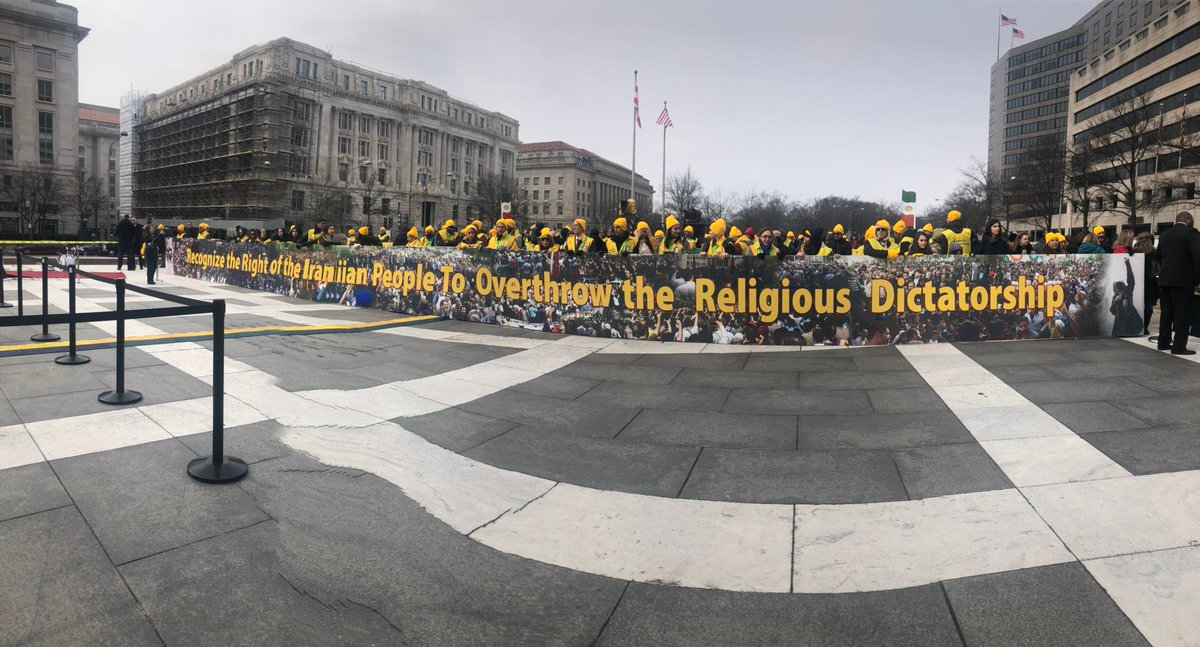
“Iran Freedom March” calling on the international community to recognize the right of the Iranian people to overthrow the religious dictatorship ruling Iran - Washington, D.C. - March 8, 2019

The Iran Freedom March rally called for a firm policy vis-a-vis the Iranian regime’s terrorism, human rights violations and security threats to global peace and security. The participants called for the international recognition of the NCRI as the democratic alternative of the Iranian regime and the representative of the Iranian people. They also voiced their support for Mrs. Rajavi’s ten-point plan, which calls for a democratic and secular state that provides equal opportunities to all Iranians regardless of their gender, religion and ethnicity. Mrs. Rajavi also calls for the dismantlement of Iran’s nuclear project, the abolishment of the death penalty and an end to meddling in the affairs of neighboring countries. “Democracy, freedom with Maryam Rajavi,” the rally participants were chanting.

https://lh3.googleusercontent.com/zyksubHl-ty-zvSbq2TsvGYEx-YJope2GOWmCjLp_LehXnyVcgbyXz13fnoeFRRziRMKP0r68eIXR7jdfPPhvgtM6FkbsccgUfqw_Z-hffB2-fTNbFU8tAlcu1A29CJ9-9yaXGEp
“Iran Freedom March” - Washington, D.C. - March 8, 2019

A delegation of women at the “Iran Freedom March” highlighting the plight and ongoing struggles of Iranian women against the mullahs’ regime - Washington, D.C. - March 8, 2019

Thursday, March 7, 2019

Zarif’s resignation continues to cause political aftershocks for the Iranian regime

Zarif’s resignation continues to cause political aftershocks for the Iranian regime


Iranian regime FM Javad Zarif
Analysis by PMOI/MEK

March 7, 2019 - About a week ago, the Iranian regime’s foreign minister Javad Zarif announced his surprise resignation on his official Instagram account and swiftly withdrew it after about 48 hours. And although both major political factions among the ruling elite in Iran did their best to normalize the scandal, there isn’t a day where a new aspect of the depth of the underlying rift and the fragility of the regime’s power structure isn’t revealed.
Zarif’s resignation was simultaneous with Syrian president Bashar al-Assad’s official visit to Tehran where he met with Iranian regime Supreme Leader Ali Khamenei and regime president Hassan Rouhani. The visit was intended to be a show of power for the Iranian regime and showcase its influence in the region in defiance of growing political and economic isolation across the world.
But Zarif’s resignation changed the whole equation for the Islamic Republic.
Not only did the news of the Syrian dictator’s visit to Tehran become eclipsed by the internal political controversy, but political fragility in the top tier of the Iranian ruling elite was also added to a whole lot of other major problems that the ruling mullahs in Iran face since the popular uprising in December 2017.
Iranian pundits from both factions agree that the resignation theatre damaged the whole regime.
Now, after decisions about the fate of the FATF bills in the Iranian Expediency Discernment Council have been postponed, some so-called reformists claim that Zarif withdrew his resignation because he was able to secure a promise to approve the required bills to join the world’s de facto anti money-laundering body.
Opponents don’t agree.
Hossein Mozaffar, member of the Expediency Council from Khamenei’s faction and a former minister in Mohammad Khatami’s government, said on March 3: “Zarif’s resignation will have no impact at all in the decision-making process of the related bills.”
“This resignation at the time of Bashar Al-Assad’s important visit of the Supreme Leader has damaged Zarif’s political credibility internally and on the international stage,” he added.
“We thought about him [Zarif] differently and we thought that Zarif is more resilient. Maybe Zarif was under pressure, nevertheless his action [resignation], especially at that point in time, was wrong,” he said.
Siasat-e Rooz newspaper, close to Khamenei’s faction, wrote on March 2: “With a political blackmail in terms of the country’s FM resignation, the foreign policy establishment was trying to put pressure on the Expediency Discernment Council to swiftly approve the four FATF bills.”
Although Iran newspaper, the government’s mouthpiece, reiterated Zarif’s commitment to the Islamic Republic on March 2 and wrote that “his statements didn’t violate the regime’s major policies and views in the slightest way,” Javan newspaper, a semi-official outlet for the Islamic Revolutionary Guards Corps., described Javad Zarif’s resignation “a malign scenario with the goal of drawing an issue into the public.”
“We shouldn’t forget that Zarif’s resignation has also revealed some people’s hypocrisy, deception, and conflict of interest. Those people who have for years considered the government and the likes of Zarif without power and authority and used terms like ‘the selective sector’, ‘the hidden government’, ‘they don’t let the government work’, etc. for the public; Fortunately, Zarif’s resignation has revealed this hypocrisy and conflict of interest in presenting a dual picture of the relations between parts of the government,” Javan further wrote.
Asadollah Badamchian, spokesperson for the regime’s Islamic Coalition Party, considered Zarif’s resignation a mistake at the worst possible time and said: “The foreign minister should have take advantage of the opportunity of Bashar Al-Assad’s important visit and made a decision at a proper time.”
Meanwhile, Rouhani’s cronies are gradually revealing the rifts in the foreign policy establishment and talk about meddling by organizations close to Khamenei.
Mohsen Aminzadeh, former deputy foreign minister of Mohammad Khatami, said on March 2: “The reason behind Zarif’s resignation is the meddling of irresponsible security and military organizations, especially the Quds Force, in foreign policy [matters]. Since assuming his post in 2013, Zarif was facing this big problem. In the process of Bashar Al-Assad’s visit to Tehran, this problem has presented itself more clearly.
“Indeed, meddling in foreign policy isn’t limited to the Quds Force. Other military and security institutions also meddle in foreign policy. These meddling are so frequent that you can say that such an extreme situation is unprecedented.”

Wednesday, March 6, 2019

Prominent European dignitary publishes new report on Iranian opposition PMOI/MEK

Prominent European dignitary publishes new report on Iranian opposition PMOI/MEK


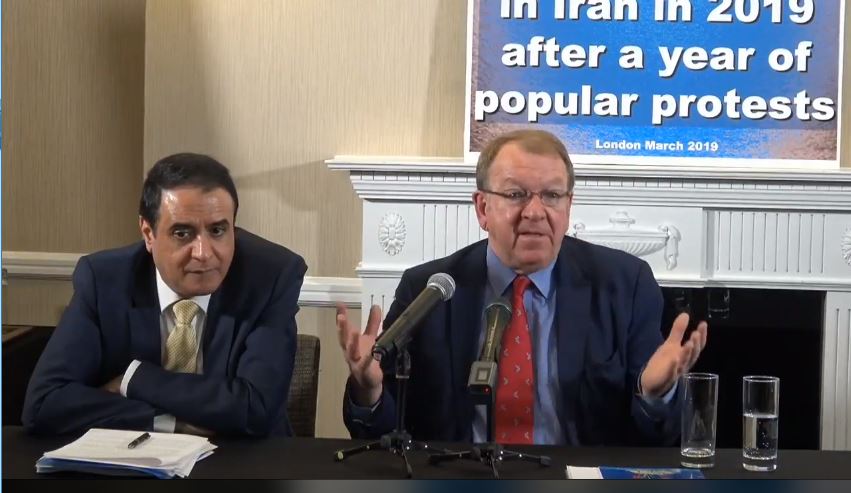
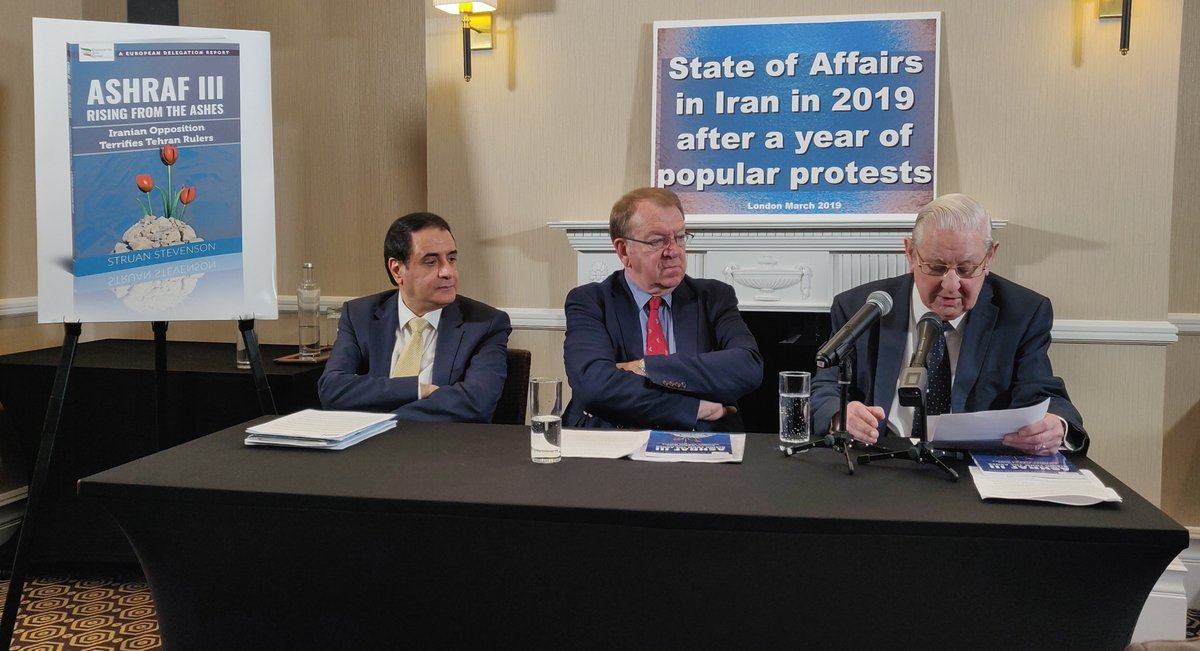
Former MEP Struan Stevenson at a London press conference announcing the publication of his new report on Iranian opposition PMOI/MEK – March 5, 2019
Reported by PMOI/MEK

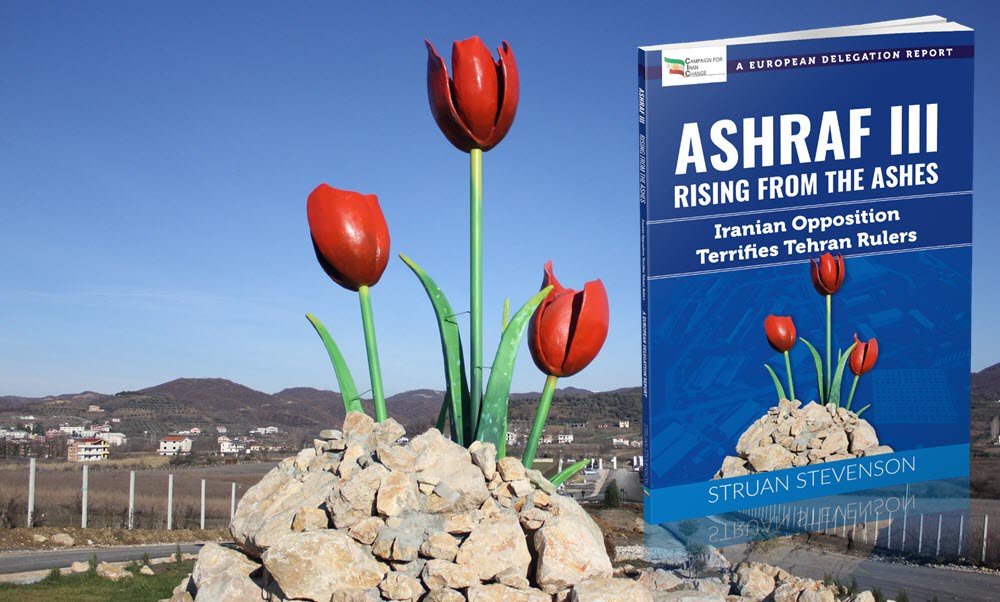
London, March 5, 2019 - “Ashraf III – Rising From The Ashes” is the title of a new report published by Struan Stevenson, a prominent former member of the European Parliament and a known expert on Middle East affairs, especially Iraq. The report, presented on Tuesday at a London press conference, provides a detailed explanation on why the mullahs’ regime ruling Iran is escalating its propaganda campaign and terror measures against the People's Mojahedin Organization of Iran (PMOI/MEK), the main member of the Paris-based Iranian opposition coalition National Council of Resistance of Iran (NCRI).

https://pbs.twimg.com/media/D05FzMRXgAAeGBY.jpg
“Ashraf III – Rising From The Ashes” – By Struan Stevenson

Through his remarks, Stevenson highlighted how Tehran continues to intensify repression at home after the so-called “moderate” regime President Hassan Rouhani took office, parallel to the recent surge in the number of terrorist plots and propaganda campaigns carried out by the mullahs’ regime against the NCRI, and specifically targeting the PMOI/MEK.
“The regime plotted to bomb a rally in Paris. I was at that rally. Several other terror plots were perpetrated by Iranian regime agents in Europe,” Stevenson explained, referring to Tehran’s plot to target the annual Iranian diaspora rally on the outskirts of Paris where tens of thousands of Iranians join hundreds of prominent dignitaries from across the globe to express their support for NCRI President Maryam Rajavi and her ten-point plan for Iran. “But despite all that we still have Europeans trying to sign trade deals with Iran as part of an appeasement policy. These countries have shamefully set up INSTEXT to bypass U.S. sanctions in a somewhat barter system.”
Stevenson turned his remarks on recent developments in Iran.
“Only two days ago, Iran appointed Ebrahim Raisi, the notorious executioner of thousands only for their support for the PMOI/MEK. How on Earth can we have dialogue with a regime that appoints a man with such atrocities to head of judiciary?” he asked in reference to the role of Raisi as a senior member of the notorious “Death Committee” that sent thousands of political prisoners to the gallows during the summer 1988 massacre. Over 30,000 dissidents, mostly PMOI/MEK members and supporters, were executed in kangaroo “courts” that lasted mere minutes.
“The sudden resignation of Iranian Foreign Minister Mohammad Javad Zarif and the uprising show the fragile status of the regime,” Stevenson said, highlighting the numerous crises engulfing the mullahs’ regime. “The insistence of Revolutionary Guards Quds Force chief Qassem Soleimani on Zarif’s reinstatement show how these two figures are working together on the regime’s foreign terrorist organization.”
Stevenson adjusted his speech onto the main Iranian opposition force, the PMOI/MEK, threatening the regime in Tehran.
“Following the airlift of over 2,000 Iranian dissidents [from Iraq to Albania], the mullahs couldn’t tolerate it and sent dozens of agent to Albania. The mullahs’ regime began planning bomb plots and assassinations in response,” he added. “Mrs. Maryam Rajavi and her people built a whole city in a matter of months. Ashraf.  That is why I call it ‘rising from the ashes.’”
Tehran has also launched a demonization campaign against the PMOI/MEK based in Albania.
“Ann Singleton actually held a press conference in Albanian claiming to work for the UK government as an anti-terrorism expert. Two Londoners, Masoud Khodabandeh and his wife, Singleton, who have sinister records and have been seen outside Ashraf in Iraq planning rocket attacks on the residents, are now regularly visiting in Albania,” the former MEP continued.
“The people of Iran now look to the organized opposition [the PMOI and the NCRI] as the harbingers of a future of democracy, justice, and peace. The fortitude and stamina of PMOI members in Albania has acted as a beacon of hope for the 80 million beleaguered citizens of Iran who hope and pray for freedom from oppression… The Iranian people have lost their fear and are demanding ‘regime change.’ We have a regime that has executed 4,000 only during the so-called moderate Rouhani’s tenure. After 40 years of dictatorship, today 80 million Iranians have had enough.”

https://pbs.twimg.com/media/D05SucxXgAAboO-.jpg
Former MEP Struan Stevenson at the London conference announcing his new report – March 5, 2019

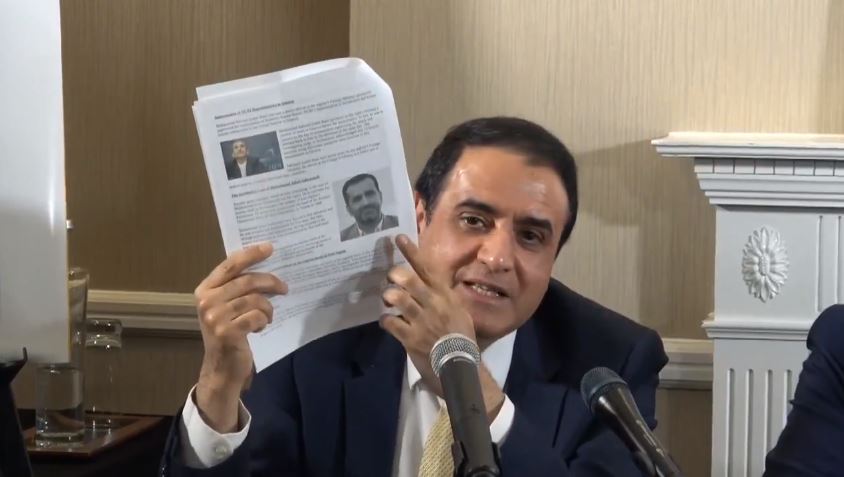
Hossein Abedini, a member of the NCRI Foreign Affairs Commission, shed light on the terror campaign launched by Tehran especially through the course of 2018. He showed documents exposing Iranian agents using diplomatic passports and immunity to plot and carry out terrorist attacks on European soil and other foreign countries. Qassem Soleimani is using diplomatic passport to travel to foreign countries, he explained.
Reza Amiri Moghaddam, a former head of the Iran delegation to Iraq, came to Europe and engaged directly with Assadi to plot terror attack targeting the Paris rally back in late June 2018.
“It is not a secret anymore that all Iranian regime departments and figures, including Rouhani and Zarif, are involved in terrorism and there is no difference between their factions. Zarif is the ‘smiling face’ of a terrorist,” he explained.
“The moderation of this regime has been an invalid claim. Last summer, Rouhani put an end to this. He assigned his Intelligence Ministry to carry out a terror attack against the Iranian opposition rally near Paris,” Abedini continued.
“It is time for Europe to listen to people of Iran and black list the regime’s Ministry of Intelligence & Security and the IRGC as foreign terrorist organizations,” he added. “The mullahs’ regime only understands the language of firmness. The UK government blacklisting Hezbollah, which is on the payroll of the mullahs’ regime in Iran, is a good move but not enough.”

https://pbs.twimg.com/media/D05JaavX0Ac6q-D.jpg
NCRI member Hossein Abedini at a press conference in London – March 5, 2019

Lord Clarke of Hampstead, CBE, also attended the London press conference.
“After one year of popular protests in Iran against the regime, the world and Iran experts now understand and admit that the people want genuine change and freedom,” he said.

https://pbs.twimg.com/media/D05Fuz1W0AAqer2.jpg
Lord Clarke of Hampstead, CBE, at the London press conference – March 5, 2019

Tuesday, March 5, 2019

Khamenei’s tweet again proves the need for a firm Iran policy

Khamenei’s tweet again proves the need for a firm Iran policy


Mullahs’ Supreme Leader Ali Khamenei – (File Photo)
Analysis by PMOI/MEK

March 2, 2019 - Twitter recently removed a tweet by the mullahs’ Supreme Leader Ali Khamenei in Iran citing abusive behaviors. Khamenei was informed he would not be allowed to continue using Twitter until he removes that particular tweet and observed Twitter rules.
It is ludicrous for the self-proclaimed supreme leader to reiterate a fatwa issued by his predecessor, regime founder Ruhollah Khomeini, for the sake of convincing and rallying up his loyalists. This is considered a desperate and unusual measure to gain their trust and boost their morale.
This comes at a time when his regime is facing increasing international isolation and public recession inside Iran.
In January 1989, Khomeini Issued a Fatwa (religious edict) calling for the killing of British author Salman Rushdie. This launched a massive uproar and crises at the time.
While issuing such a license to kill in itself talks volumes about the tyrannical and reactionary nature of Khomeini, it was also an opportunistic and self-serving measure to cover up his failure in Iran-Iraq war by having to accept UN Security Council Resolution 598, which he described as the chalice of poison.
Of course, Rushdie's book had already been published for some time before Khomeini seized the opportunity to ride waves of protests, some turning out to be deadly in India and Pakistan.
With rising voices of protests, even from his own inner circle and high-ranking regime officials, Khomeini saw a golden opportunity to divert attention and to supposedly “unite” the Muslim world.
However, Khamenei’s attempt at a similar gesture, at a time when the JCPOA has literally come to failure, is somewhat far different. His Friday prayers imams openly admit that Khamenei’s words no longer carry any weight.
Recently he issued a statement urging different factions to refrain from bickering during the regime’s 40th anniversary, only to fall on deaf ears.
Under the circumstances, creating tensions appears to be Khamenei’s prescription to get through the difficult status quo, kicking the can down the road.
Khomeini’s 1989 fatwa resulted in the Europeans pulling out their diplomats from Iran. However, the overall policy of appeasement by the Europeans turned a blind eye to this issue, being a violation of all international laws and principals.
Europe, and indeed all other countries wishing to put an end to the mullahs’ state-sponsored support for terrorism, should have realized by experience that the only way to stop that wave of terror is to adopt a firm policy vis-à-vis Tehran.
The mullahs’ regime ruling Iran is a threat to the region and the world. All sources of its finance and channel of communications to misinform and pervert public opinion should be blocked.
Allowing the mullahs of Tehran and their lobby to take advantage of mainstream media and social media networks will only lead to more such episodes, including Tehran’s mullahs encouraging further exporting of terrorism and human rights violations.

Monday, March 4, 2019

Iranian newspaper: Javad Zarif is that tinkered porcelain that is more likely to break

Iranian newspaper: Javad Zarif is that tinkered porcelain that is more likely to break


Zavad Zarif (Left) and Hassan Rouhani (right), FM and president of the Iranian regime
Analysis by PMOI/MEK

March 2, 2019 - In its February 28 editorial, state-run newspaper Siasat-e Rooz described Iranian foreign minister Javad Zarif as a tinkered porcelain that is good for inferior use.
“Everybody believes that Zarif’s resignation considering his post was wrong. We also believe that it was a miscalculation in a delicate situation,” Siasat-e Rooz writes.
“Considering his resignation, Zarif’s presence in the foreign ministry makes ‘no difference.’ Zarif broke himself, but the ‘porcelain tinkerer,’ even if he fixed a good [quality] broken porcelain, will it have its previous functionality?” the newspaper further writes.
“While the people are witnessing skyrocketing prices and sort of an explosion in living items’ prices because of a lack of managerial measures, controversies like Zarif’s resignation, and that for not inviting him to be present in an unofficial and undiplomatic meeting, can render the people hopeless toward the system in terms of managing the economic and living situation,” the editorial concludes.
On the same day, Keyhan newspaper, Iranian regime Supreme Leader Ali Khamenei’s semi-official mouthpiece, wrote: “It begs the question who pays the price of the president’s lack of coordination with different ministers (and not just Zarif), Rouhani or the establishment? Anti-revolutionary media welcomed Zarif’s resignation and were thrilled about it. Unfortunately, Zarif’s rash and unconventional move has impacted ‘Bashar Assad’s’ very important visit to Tehran… Zarif is back, but the costs remain. In fact, Zarif’s rash and unconventional move caused some damages.”
Javan, another state-run newspaper, also wrote on February 28: “Some in the country and most of the foreigners described this really washy resignation as a sign of the deteriorating situation of the Islamic Republic and even asked the Iranian president to courageously and grandiosely resign following the minister!”
On the other hand, newspapers close to Rouhani’s faction also acknowledge the deep crisis presented by Zarif’s resignation.
Arman newspaper writes: “The quantity and variety of decision makings outside of the government has created problems for the executive system with many negative consequences. Even foreigners are confused by the multiplicity of opinions and policies and don’t trust in the official foreign policy apparatus anymore.”
“Foreign governments can consider Mr. Zarif’s resignation as a sign of diplomatic weakness in Iran which will have cost for the country in terms of national interests and international political credit,” Arman further writes.
Fararu website published an article titled, “Zarif was cut between two swords or two scissor blades” and writes: “This resignation shows that the government has not much of a role in designing the foreign policy.”
Quoting Mehdi Motaharnia, a pundit from Rouhani’s faction the website further writes: “It is clear that power and policy making is not within the government. This has a very sharp and important meaning and with Zarif’s resignation, it has put an end to the government’s stature within the Iranian political system in relation with the international system. In an international sense, the Iranian government and the foreign ministry will have no meaningful and influential functionality.”

Saturday, March 2, 2019

Iran’s currency devaluation is the result of a joint conspiracy of the government and the parliament

Iran’s currency devaluation is the result of a joint conspiracy of the government and the parliament


Iran’s currency devaluation
Analysis by PMOI/MEK

Feb. 28, 2019 - While the Iranian national currency is devaluated again to 140,000 rials against the U.S. dollar, controversies and discussions about the roots of the problem have increased again.
Hassan Rouhani’s government maintains U.S. sanctions are at the root of inflation, decrease of purchasing power and increase in U.S. dollars value against the national currency. But other Iranian pundits believe that other parameters like a conspiracy between the government and parliament to sack the people are at works.


On February 24, the Iranian television broadcasted a program about the roots of the recent spike in exchange rates, featuring Hossein Raghfar, a well-known Iranian regime economist, who said about the unexpected surge of U.S. dollar against the rial: “Unfortunately, the so-called private banks in the country are facing serious financial problems and the government and parliament imagine that by increasing foreign currencies’ value [against the Iranian rial] they can provide enough resources to compensate for the private banking sector’s wrongdoings.  The whereabout of a significant part of the people’s deposits with these banks is unclear.”
“The government and parliament have commonly decided to cover this out of the people’s pockets, meaning that by increasing foreign currencies’ values, this is what is going to happen practically. Therefore, people will sleep at night and wake up in the morning to see that their savings in banks has lost 20 to 30 percent of its value and their purchasing power has diminished significantly,” he added.
“The last shock to the exchange rate will disrupt the whole economy, manufacturing will definitely stop, some very simple calculations will show that at least one million official jobs will be destroyed,” Raghfar said about the catastrophic impact of the conspiracy between the government and parliament to increase the U.S. dollar’s rate.
ISNA news agency also published an article titled “who is the culprit of the increase in dollar’s exchange rate” and writes: “Considering that there hasn’t been any negative development in the foreign relations field, it appears that the root of increasing exchange rates is internal and currently, the central bank sees the government as the culprit of inflation.”
Even Jahan-e Sanat newspaper, close to Rouhani’s faction, called the government’s promises untrustworthy and wrote on February 22: “You can’t trust the government’s promises anymore when it plays with the pace of the market and every other day makes the situation for its people more difficult with another decision and perspective. As long at the deficits are covered from the pockets of the people, the situation will become worse than it is right now.”
Arman Hajian Fard, an economic analyst, says in an interview with the IRGC Quds Force’s Tasnim news agency: “The wage of an Iranian worker is among the lowest wages payed to workers in the world… The poverty line has reached 60 million rials [about 430 USD at an exchange rate of 140,000 rials to the USD] and living costs of a family have increased 80 percent compared to January 2018 and reached 50 million rials [per month] and in summer 2018 the people living below poverty line have increase from 12 to 50 percent [of the population].”
The formal minimum monthly wage in Iran is about 14 million rials for a father of a family of four who works 6 to 8 hours a day, 6 days a week, which isn’t even 30 percent of the official living costs of a family.

Friday, March 1, 2019

Tehran’s terror mastermind voices support for Iranian regime FM

Tehran’s terror mastermind voices support for Iranian regime FM


Iranian regime foreign minister Zavad Zarif (left) and IRGC Quds Force commander Qassem Suleimani (right)
Analysis by PMOI/MEK

Feb. 28, 2019 - The top commander of the Iranian regime’s notorious Quds Force stated his support for foreign minister Javad Zarif after the latter declared his resignation from his post earlier this week.
“Zarif is in charge of the foreign policy of the Islamic Republic and has the approval of senior establishment officials, especially [Iranian regime supreme leader Ali] Khamenei,” said Qassem Suleimani, who has been at the helm of the Quds Force’s operations for more than two decades. “During the visit of [Syrian regime president] Bashar al-Assad to Tehran and his meeting with Rouhani, there was a lack of coordination in the presidential institution, which resulted in the absence of the FM and his dissatisfaction.”
On Monday, Zarif declared his resignation in an Instagram post after he was sidelined in Assad’s visit to Iran. Zarif’s resignation triggered controversy in the highest levels of power in the Iranian regime. Regime President Hassan Rouhani did not accept Zarif’s resignation, and the FM was back in office soon after, doing photo ops with a delegation from Armenia that had traveled to Iran.
It’s very hard to believe that not bringing the foreign minister to an important meeting with a foreign delegation from a top regime ally has been mere miscoordination. But Suleimani’s remarks indicate some very important facts.
The resignation (and overnight return) of Zarif is testament to the crises that are riddling the Iranian regime at all levels and the deadlocks that the regime is facing on different important issues such as the nuclear deal and FATF regulations, a set of international regulatory requirements that will shorthand the regime in its funding of terrorist groups. Rivaling ruling factions are virtually at each other’s throats and blaming each other for the different problems that the regime is facing.
After his short-lived resignation, Zarif lamented that infighting among Iranian officials was like poison for the regime.
Also, it’s ironic to see the mastermind of the regime’s terror apparatus to voice his support for Zarif, which many western politicians describe as "moderate" and "soft-spoken." Suleimani’s Quds Force is the main entity behind the regime’s foreign terrorism and has been designated as a terrorist organization by the U.S. since 2007.
In the past year, the regime has increased its terror activities abroad, especially in Europe, against members and supporters of the Iranian opposition. The terror plots have been carried out and planned through the regime’s embassies and diplomatic channels and in direct coordination with the regime's foreign ministry.
Suleiman’s support for Zarif shows how much the latter is vital to the regime’s foreign terrorism campaigns. Rivaling regime factions might quarrel over minor issues, but when it comes to terrorizing Iranian opposition members, they are of a like mind.