Sunday, June 9, 2019

New US sanctions target Iran’s petrochemical industries

New US sanctions target Iran’s petrochemical industries


US Department of Treasury
Analysis by PMOI/MEK

Iran, June 8, 2019 - The United States Treasury Department hits Iran’s regime with new sanctions targeting the mullahs’ vital petrochemical industry. The new sanctions come while Washington is increasing pressures on Tehran for its ballistic missiles and proxy wars across the region.
The U.S. Treasury said Iran’s oil ministry last year awarded Khatam al-Anbiya, the economic and engineering arm of the regime’s Revolutionary Guards (IRGC), ten projects in the oil and petrochemical industries worth $22 billion, four times the IRGC’s official budget.
The Treasury’s Office of Foreign Assets Control (OFAC) took action against Persian Gulf Petrochemical Industries Company (PGPIC), Iran’s largest and most profitable petrochemical holding group, for providing financial support to the Khatam al-Anbiya Construction Headquarters.
Additionally, OFAC is designating the PGPIC’s vast network of 39 subsidiary petrochemical companies and foreign-based sales agents.  PGPIC and its group of subsidiary petrochemical companies hold 40 percent of Iran’s total petrochemical production capacity and are responsible for 50 percent of Iran’s total petrochemical exports.
“By targeting this network we intend to deny funding to key elements of Iran’s petrochemical sector that provide support to the IRGC,” said U.S. Treasury Secretary Steven T. Mnuchin.
“This action is a warning that we will continue to target holding groups and companies in the petrochemical sector and elsewhere that provide financial lifelines to the IRGC,” Mnuchin added.”
Sigal Mandelker, the U.S. Under Secretary for Terrorism and Financial Intelligence, spoke of the IRGC’s malign influence.
“The IRGC systemically infiltrates critical sectors of the Iranian economy to enrich their coffers, while engaging in a host of other malign activities,” she said.
The Treasury Department says the IRGC and its major holdings, such as the Basij Cooperative Foundation and Khatam al-Anbiya, have a dominant presence in Iran’s commercial and financial sectors, controlling multi-billion dollar businesses and maintaining extensive economic interests in the defense, construction, aviation, oil, banking, metal, automobile and mining industries, controlling multi-billion dollar businesses.  The profits from these activities support the IRGC’s full range of nefarious activities, including the proliferation of weapons of mass destruction (WMD) and their means of delivery, support for terrorism, and a variety of human rights abuses, at home and abroad.
The US administration on April, officially designated the IRGC as a Foreign Terrorist Organization (FTO). According to U.S. law, any American dealing or transacting with the IRGC could be charged with support for terrorism and get 20 years imprisonment.

https://storage.googleapis.com/afs-prod/media/eed797db758b44f78c17c9f1e8e437ce/800.jpeg
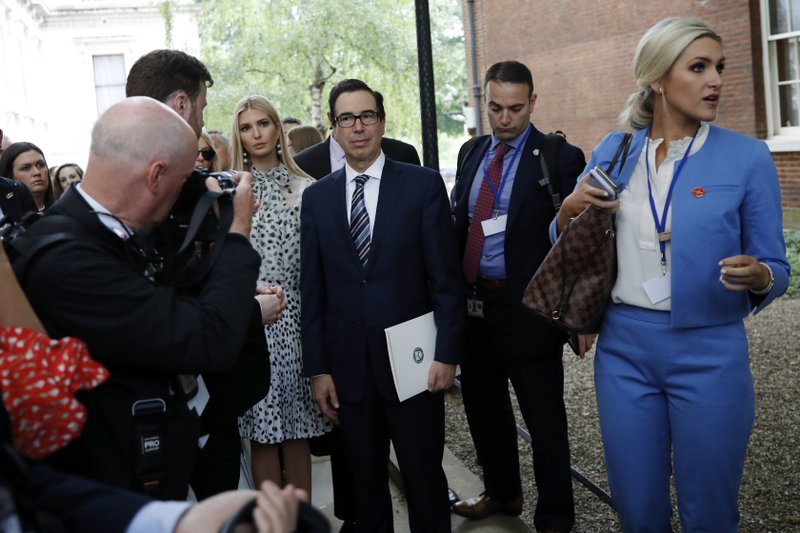
U.S. Treasury Secretary Steve Mnuchin, Senior White House Advisor Ivanka Trump and others. (AP Photo)


The following, targeted by the US Department of Treasury, are Iran-based Persian Gulf Petrochemical Industries Company subsidiary petrochemical firms owned or controlled by PGPIC.
  • Arvand Petrochemical Company
  • Bandar Imam Abniroo Petrochemical Company
  • Bandar Imam Besparan Petrochemical Company
  • Bandar Imam Faravaresh Petrochemical Company
  • Bandar Imam Kharazmi Petrochemical Company
  • Bandar Imam Kimiya Petrochemical Company
  • Bandar Imam Petrochemical Company
  • Bu Ali Sina Petrochemical Company
  • Fajr Petrochemical Company
  • Hengam Petrochemical Company
  • Hormoz Urea Fertilizer Company
  • Iranian Investment Petrochemical Group Company
  • Iranian Petrochemical Investment Development Management Company
  • Karoun Petrochemical Company
  • Khouzestan Petrochemical Company
  • Lordegan Urea Fertilizer Company
  • Mobin Petrochemical Company
  • Modabberan Eqtesad Company
  • Nouri Petrochemical Company
  • Pars Petrochemical Company
  • Pazargad Non-Industrial Operation Company
  • Persian Gulf Apadana Petrochemical Company
  • Persian Gulf Bid Boland Gas Refinery Company
  • Persian Gulf Petrochemical Industry Commercial Co.  (PGPICC)
  • Persian Gulf Fajr Yadavaran Gas Refinery Company
  • Petrochemical Industries Development Management Company
  • Rahavaran Fonoon Petrochemical Company
  • Shahid Tondgoyan Petrochemical Company
  • Urmia Petrochemical Company
  • Hemmat Petrochemical Company
  • Petrochemical Non-Industrial Operations & Services Co.

The Treasury’s Office of Foreign Assets Control (OFAC) is also designating four more companies to its sanctions list. They include:
  • Ilam Petrochemical Company,
  • Gachsaran Polymer Industries,
  • Dah Dasht Petrochemical Industries pursuant to E.O.
  • Broojen Petrochemical Company

Additionally, the Treasury’s OFAC announced that:
The UK-based NPC International
Philippines-based and NPC Alliance Corporation
UAE Based Atlas Ocean and Petrochemical and Naghmeh FZE are also being designated for acting for or on behalf of PGPICC.

The U.S. Treasury statement says international companies continuing to partner with PGPIC and its designated subsidiaries/sales agents will themselves be exposed to U.S. sanctions. The Treasury urges international companies to ensure they are conducting the necessary due diligence to avoid engaging in sanctionable activity with entities that support the Iranian regime’s malign measures. 

Friday, June 7, 2019

Iran: Khamenei’s role in recent UAE, Saudi terrorist attacks

Iran: Khamenei’s role in recent UAE, Saudi terrorist attacks


Hossein Shahroudi, representative of the Iranian regime Supreme Leader Ali Khamenei in the city of Sanandaj, western Iran
Analysis by PMOI/MEK

Iran, June 7, 2019 - Hossein Shahroudi, Friday prayer imam of Sanandaj, western Iran, acknowledged that the drone attacks targeting vital oil facilities in Saudi Arabia and the sabotage attacks targeting four oil tankers off the coast of the United Arab Emirates were carried out by the Iranian regime and directed specifically by the regime’s Supreme Leader Ali Khamenei.
Friday prayer imams in cities and towns across Iran are known as Khamenei’s personal representatives.
“Missiles are fired. Drones are sent. They have targeted the very U.S. defense systems that were supposed to provide protection. It has hit the Patriot system and yet they claim Iran is directing these attacks,” he said.
“They said we will zero your oil exports. So what? Do so if you can. Two or three incidents took place. They could not pinpoint any of them to Iran. The Fujairah incidents took place. A few ships collided with each other. And then those oil transferring systems. They thought they could transfer their oil without using the Persian Gulf by taking it to the Red Sea saying it is safe through that route. Well, these drones went and targeted those pump stations transferring this oil. They were severely damaged. Now transfer your oil. See if you can?” Shahroudi continued in his remarks.
“A bomb exploded in a military base in Tel Aviv. What happened? What are these incidents, all one after another? Everyone denied it. These things do not happen on their own. They must have a leader who knows what he is doing. Know that [Khamenei] himself is directing these incidents step by step,” he added.
Iran’s Revolutionary Guards (IRGC) is the main force behind the mullahs’ support for terrorism across the globe.
The U.S. State Department recently designated the IRGC as a “Foreign Terrorist Organization” (FTO).


Such terrorism has been a threat to waterways throughout the region.


Thursday, June 6, 2019

UN Security Council will receive tankers’ sabotage probe results

UN Security Council will receive tankers’ sabotage probe results


UN Security Council session
Analysis by PMOI/MEK

Iran, June 6, 2019 - The United Arab Emirates, Saudi Arabia, and Norway will on Thursday present to members of the United Nations Security Council the result of their investigations into the recent sabotage attack targeting four oil tankers off the UAE coast near the Fujairah port.
This report was provided by Channel News Asia on Wednesday citing unspecified diplomatic sources. The U.S. is insisting that Iran was behind the attacks.
U.S. National Security Advisor John Bolton says Iranian made sea mines have most likely been used in these sabotage attacks.
Last week Ambassador Bolton said his country will provide the Security Council with documents showing Tehran’s involvement in the Fujairah bombings.
During his trip to London, Bolton reiterated the Iranian regime’s threats in the Middle East have not come to an end, insisting U.S.’ “immediate” reaction to Iran’s threats helped neutralize these threats.
The Wall Street Journal cited Ambassador Bolton’s comments on Wednesday saying the U.S. has little doubt that Iran was behind the attacks.
 “Who else would you think was doing it?” he asked, declining to give details of the assessment. “Somebody from Nepal?”
Another U.S. official told the WSJ that on the night of the tanker attacks, an American destroyer, the USS Mason, tracked 20 Revolutionary Guards (IRGC) sea vessels leaving Iran, crossing international waters and entering UAE waters near the port of Fujairah, where nearly 100 tankers were waiting to pass through the Strait of Hormuz.
The Saudi Gazette also cited Bolton saying the U.S. will next week provide the UN Security Council with findings showing Tehran’s in the oil tankers’ sabotage off the UAE coast.

Wednesday, June 5, 2019

Iran: Khamenei remarks reflect regime’s desperate nature

Iran: Khamenei remarks reflect regime’s desperate nature


Iranian regime Supreme Leader Ali Khamenei
Analysis by PMOI/MEK

Iran, June 5, 2019 - The speech delivered by Iranian regime Supreme Leader Ali Khamenei on Tuesday marking the death of regime founder Ruhollah Khomeini shed important light into how the mullahs’ regime faces a devastating dead-end as domestic and international crises escalate.
“You saw the massive turnout during the February 11th march,” he said in reference to the regime’s founding anniversary. “When you turned out in large numbers this Friday, during Quds Day, you disrupted the enemy’s calculations and planning.”
This proves how utterly desperate the mullahs’ regime has become and seeks to lift the spirit of their forces as the noose of dilemmas further strangles Tehran’s rulers.
Moreover, in a warning to the faction close to Iranian regime President Hassan Rouhani, Khamenei warned any step back against U.S. sanctions will be far more dangerous.
“Whenever we stood firm and resisted, we were able to pursue our goals. Whenever we surrendered or took a step back, we have suffered immensely… Resistance is possible, which is the exact opposite of those who continuously say there is no use and our adversaries are too strong. Choosing to resist, of course, comes with a price tag. However, surrendering before the enemy is far more destructive,” Khamenei added.
All the while, Khamenei revealed his fear by preventing the crowd from chanting anti-U.S. slogans.
“Please, listen. Please. We are not discussing any battle with the U.S. The issue of battle is another topic. I am talking about perseverance, resistance and not retreating. Please listen carefully,” he emphasized.
Khamenei also expressed his dire concerns about recent remarks made by U.S. President Donald Trump, describing the U.S. readiness for talks as “political deception.”
“Officials of the Islamic Republic should not be deceived. People should not be deceived. The Americans should not get any close to us,” he said.

Tuesday, June 4, 2019

Iran: 4,600 young people arrested during the January 2018 uprising

Iran: 4,600 young people arrested during the January 2018 uprising


The January 2018 uprising
NCRI, June 3, 2019 - Iran's Islamic Revolutionary Guard (IRGC) member, Hassan Abbasi, in an interview with the state television, acknowledged that during the uprising of 2018, about 4,600 young people were arrested by repressive forces. He rejected the possibility of any "velvet revolution" or "color revolution" in Iran, saying: "4500-4600 of these young people in the street who were arrested in 2018." (Ofogh state TV, June 1, 2019)
The Iranian Resistance said in a statement on January 11, 2018, that the number of arrested people in Iran's nationwide uprising reached to at least 8,000. At least 14 of those arrested were killed under torture, but the clerical regime in Iran shamelessly announced they had committed suicide in prison.
Political arrests have continued continuously since the uprising of 2018 until now, and many of them are still in jail and sentenced to long term prisons. Two weeks ago, a political prisoner named Abdollah Ghassempour was sentenced to death on mullahs-made charges of "aggression", "assembly and collusion against the regime" and "membership and propaganda and cooperation with the PMOI", and three others were sentenced on similar charges, to five and half years prison.
The Iranian Resistance, emphasizing that political prisoners are subject to torture and executions, calls for urgent action by the Secretary-General of the United Nations, the High Commissioner and the Human Rights Council of the United Nations and international human rights organizations to release the detainees and to designate delegations to visit regime prisons and to meet with political prisoners.
Secretariat of the National Council of Resistance of Iran   
June 3, 2019

Monday, June 3, 2019

Iran’s regime responds to Arab conferences

Iran’s regime responds to Arab conferences


Leaders form the Arab World gathering in Mecca for a series of conferences focusing on regional threats emanating from Iran
Analysis by PMOI/MEK

June 3, 2019 - Three conferences held in the holy city of Mecca, Saudi Arabia, featuring leaders from a spectrum of Arab and Islamic countries, was deemed unprecedented in the past. This represented a significant political alignment of these countries against the mullahs' regime ruling Iran, especially as these conferences coincided with Tehran’s deceptive “Quds Day” rally.
While Tehran intended to hold its annual “Quds Day” rally to derive attention away from its recent acts of terrorism and warmongering, these Mecca conferences literally delivered a strong blow to the mullahs’ intentions as regional crises continue to escalate. Leaders of the Arab and Islamic countries emphasized on the issue of Palestine in the face of the Iranian regime’s sham “Quds Day” façade, terrorism and warmongering.
The conferences also strongly condemned the terrorist attacks carried out by Tehran’s proxy forces targeting four commercial ships off the coasts of the United Arab Emirates and vital oil facilities inside Saudi Arabia. Participants in these conferences called on the international community to rise to their responsibilities in safeguarding regional peace and security.
In a weak response, the mullahs’ regime issued a piece in a newspaper associated with the Revolutionary Guards (IRGC) indicating how the Mecca conferences delivered a deep impact on Tehran.
“… a number of Arab statesmen gathered in three consecutive conferences to point their arrow of threats towards Tehran. They condemned the Islamic republic’s foreign and regional policies,” the piece reads in part.


Arab reaction

The Iranian regime does not respect the sovereignty of neighboring nations, the London-based Asharq al-Awsat wrote citing Saudi Minister of State for Foreign Affairs Adel al-Jubeir. The Islamic world does not accept this regime’s behaviors. Two sessions of the Gulf Cooperation Council and Arab League leaders condemned the Iranian regime with a clear voice. The Organization of Islamic Countries Summit also condemned the Iranian regime’s behaviors, such as attacks on oil tankers and Saudi oil facilities, al-Jubeir added.
Iran’s IRGC is the main force behind the mullahs’ support for terrorism across the globe.
The U.S. State Department recently designated the IRGC as a “Foreign Terrorist Organization” (FTO).


Sunday, June 2, 2019

Iran: Negotiating at the dead-end

Iran: Negotiating at the dead-end


Negotiating at the dead-end
Analysis by PMOI/MEK

Iran, June 2, 2019 - Last Wednesday, Iranian regime President Hassan Rouhani once again defied expressive orders issued by the mullahs’ Supreme Leader Ali Khamenei that any sort of negotiating is a fatal poison and raised the issue of negotiating with the U.S. in a manner as if it is America that needs to negotiate with Tehran.
“Whenever they come back to the negotiations table that they left in the first place, the path is open before them,” Rouhani said during a recent cabinet’s meeting.
Following the remarks of U.S. President Donald Trump in Japan, saying his country does not seek regime change in Iran, the internal disputes among the ruling elite in Iran have actually been escalating dramatically.
The Keyhan newspaper, known as Khamenei’s mouthpiece, accuses Washington of attempting to attract Rouhani, describing these measures as “Operation hunt the kingfish.”
“Flattering the idea of a referendum as a media celebrity and painting it as a public demand can deliberately put the government in the corner and render it into a tied up opponent in front of the U.S. In this deception operation, if the enemy manages to express its needs through Iranian authorities, it has practically hunted the kingfish,” the piece reads.
“When Rouhani himself describes negotiating with the promise-breaking-U.S. as stupidity, what good will it bring to have a referendum about negotiations? Is the issue with the lack of an agreement or a lack of respecting it? Why should we bring back the ball that is already in the court of the enemy to our court?” Keyhan further writes.
The Fararou website also posted a read with a few questions on this important subject titled, “Will the softening rhetoric of Trump in Japan will solve the problem?”
“While Trump’s reiteration of solving the Iran nuclear issue can be considering America backing off from [U.S. Secretary of State Mike Pompeo’s] 12-point demands, it probably doesn’t mean that the U.S. has backed off from two issues: Containing Iran’s ballistic missiles and its regional influence. The possibility is high that Trump wants intends to initially enter the negotiations regarding the nuclear issue and begin raising other issues afterwards,” the piece reads.
According to UN Security Council Resolution 2231, the mullahs were supposed to abandon the development of long-range missiles with nuclear warhead capacities. However, they officially refrained from doing so and overtly boasted about their achievements in developing ballistic missiles.


Hamid-Reza Assefi, a former spokesman for the Iranian Foreign Ministry during Mohammad Khatami’s tenure, rejected the idea of negotiations.
“Trump wants to present something and the best product for him is to say that I’ve negotiated with the Islamic Republic and brought Iran to the negotiating table. It’s not very important for him whether these negotiations yield results or not, because he will be the winner either way,” he explained.
The state-run Ebtekar newspaper acknowledges the isolation and pressures the ruling mullahs in Tehran face.
“The presence of Europe, Russia, China and the United Nations is less significant than ever before. It appears that Europe is either busy with the European Parliament elections or is deliberately pursuing the wait-and-see policy in this struggle. Considering the capabilities of both sides, maybe Europe intends to reach a clear evaluation of its final position. Russia has decided to keep a peaceful position, saying they are not the fire brigade. China, realizing the necessity to decrease economic tensions with the U.S., is criticizing U.S. warmongering in fits and starts,” the article reads.
Ali Bigdeli, a political pundit close to the Rouhani also weighed in.
“The [2015 Iran nuclear deal] is not the only disagreement our country has with the U.S. There are other serious disagreements. For example, Iran’s presence and influence in the region will be a challenge in the future. There is no doubt that this is only an excuse for Trump to open the door of negotiations in relation to other disagreements between the two countries,” he said in a recent interview with state media.
Iran’s Revolutionary Guards (IRGC) is the source of terrorism and warmongering in the Middle East and across the globe.